
First-Time Home Buyers’ Guide to Choosing the Best Online Mortgage Broker in 7 Steps
Buying your first home is one of the biggest financial decisions you’ll ever make. With mortgage rates fluctuating and dozens of lenders competing for your business, choosing the right online mortgage broker can save you thousands of dollars—or cost you dearly if you make the wrong choice. This guide walks you through a proven 7-step process that first-time buyers are using in 2026 to confidently select an online mortgage broker that matches their needs, budget, and timeline.
Step 1: Define Your Needs and Financial Situation
Before comparing any online mortgage brokers, you need to understand your own financial picture. Start by determining your credit score, down payment amount, and target loan type. Are you looking for a conventional loan, FHA loan, VA loan, or something else? Your credit score matters significantly—most top online lenders require a minimum credit score between 620-640. Lenders like Rocket Mortgage, loanDepot, and AmeriSave all accept borrowers with a 620 minimum credit score, while AmeriSave requires 640. If your credit is lower, Northpointe Bank specializes in bad credit mortgages.
Calculate how much you can afford to borrow using online calculators available on platforms like Bankrate and NerdWallet. Know your approximate down payment percentage—this affects which lenders will work with you. Some lenders require 5% down (loanDepot), while others accept 3%. This single difference could eliminate or include certain lenders from your consideration.
Step 2: Shortlist Online Brokers Based on Speed and Accessibility
Time is money in the mortgage world. The fastest online brokers can show you prequalified rates in minutes without impacting your credit score. Here are the current market leaders in 2026:
Credible stands out for speed, delivering real, personalized rate offers in approximately 2 minutes using a soft credit pull. It has earned a 4.7-star rating on Trustpilot and doesn’t share your data until you choose a lender—protecting your privacy while you shop.
LendingTree connects you with 500+ lenders through a single form, delivering multiple competing offers within minutes. With over 65 million loan requests processed since 1996 and a 4.2-star Trustpilot rating, it’s one of the largest marketplaces. The platform’s strength is breadth—more lenders mean better odds of finding competitive rates.
Better Mortgage has emerged as the fastest online lender, allowing preapproval in as little as three minutes with no hard credit check. Eligible borrowers can receive a commitment letter—proof you’ve passed initial underwriting—within 24 hours, the fastest turnaround among major lenders.
Bankrate offers a different approach, providing a snapshot of current advertised rates within minutes before you commit to detailed forms. With ~100 partner lenders and a trusted 40-year reputation, it’s ideal if you want to browse before diving deep.
If privacy is your priority, Zillow’s mortgage marketplace lets you submit requests anonymously. Lenders can’t contact you unless you initiate conversation, eliminating unwanted spam calls—a major pain point for first-time buyers.
Step 3: Check Licensing, Reviews, and Regulatory Compliance
Not all online mortgage brokers are created equal. Verify that any broker you’re considering is properly licensed in your state. Check the Nationwide Multistate Licensing System (NMLS) database to confirm licensing status and complaint history. Read recent reviews on Trustpilot, Google, and the lender’s own website, but weight recent reviews more heavily than older ones.
Look for specific complaints about application processes, communication, or closing delays. First-time buyers should prioritize lenders with strong customer service ratings. PenFed Credit Union consistently ranks highest for interest rates among all institutions and offers easy membership (just a $5 savings account deposit). Guild Mortgage specializes in self-employed borrowers if that applies to you. Bank of America and Chase are solid national bank options with extensive branch networks if you prefer hybrid online-plus-in-person service.
Step 4: Compare Rates, Fees, and Loan Products Transparently
This is where most first-time buyers stumble. Get actual rate quotes from at least 3-5 different brokers. When comparing, ensure you’re looking at the same loan type, term (15-year vs. 30-year), and down payment percentage. Small differences in these variables make rate comparisons meaningless.
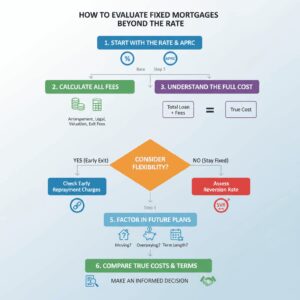
Watch for hidden fees. AmeriSave charges a $500 application fee upfront—factor this into your total cost. loanDepot doesn’t list lender fees on their website, so you’ll need to ask directly. Better Mortgage is known for minimal lender fees, making it attractive for cost-conscious buyers. Use online mortgage calculators to compare total cost of loan (principal + interest + fees) rather than just interest rate.

Verify what loan products each broker offers. If you need a USDA loan or home equity line of credit, loanDepot and AmeriSave won’t help—they don’t offer these products. New American Funding offers a wider menu of loan products including renovation loans and first-time buyer assistance programs.
Step 5: Test Digital Tools and Customer Support Before Committing
Your online broker will be your primary contact for 30-60 days. Test their digital tools and support quality before formally applying. Can you upload documents easily? Is the portal intuitive? How quickly do they respond to questions?
NerdWallet combines rate comparison with licensed broker support, offering personalized help if you want guidance beyond self-service tools. Andrews Federal Credit Union offers an exceptionally informative online rate quote tool. AmeriSave promises same-day pre-approval and phone support, important if you need human contact.
Start with a soft inquiry (which doesn’t affect your credit score) to test the platform. Most brokers offer this. Credible, Better Mortgage, and Bankrate all allow you to check rates with soft pulls first.
Step 6: Understand Credit Impact and Timing
Multiple hard credit inquiries within 14-45 days typically count as a single inquiry for credit scoring purposes, so don’t panic about applying to several lenders. However, each application does create a hard inquiry. Space out applications strategically—get soft quotes first, then move to hard inquiries from your top 2-3 choices within a 2-week window.
Understand that soft pulls (used by Credible and Better Mortgage for initial quotes) don’t affect your credit score at all. This is your advantage—shop freely without penalty. Only move to hard pulls when you’re serious about a specific lender.
Step 7: Make Your Final Choice and Lock Your Rate
After completing steps 1-6, you should have 2-3 finalists. Compare not just rates and fees, but also closing timeline, communication style, and support quality. First-time buyers often underestimate how important responsive customer service is during the stressful closing process.
Once you’ve chosen your broker and received a Loan Estimate (required by law within 3 business days of application), you have 10 days to lock your interest rate. Don’t lock immediately—wait to see if rates drop. Most brokers allow one free rate lock extension, so ask about this policy.
Verify your Loan Estimate carefully. The APR should be slightly higher than the interest rate (it includes fees). The total fees should match what you were quoted. If anything seems off, ask before proceeding to underwriting.
The Bottom Line for First-Time Buyers in 2026
The best online mortgage broker for you depends on your priorities. If you value speed and simplicity, Better Mortgage or Credible are your best bets. If you want maximum lender choice, LendingTree with 500+ partners can’t be beaten. If you prioritize low rates, PenFed consistently delivers. If privacy matters, Zillow keeps lenders at arm’s length until you’re ready.
The key is following this 7-step process rather than picking a broker randomly. You’ll save thousands of dollars and avoid costly mistakes. Start today by defining your financial situation, then move through the remaining steps at your own pace. The mortgage market is competitive—use that to your advantage.
Unlock Full Article
Watch a quick video to get instant access.