Stop Fighting About “Fair”: How To Build a Couples Money Planner That Works When Your Incomes Don’t Match

When one of you makes a lot more than the other, a simple 50/50 split can quietly turn date nights into resentment. The higher earner feels used, the lower earner feels broke, and every bill becomes a referendum on who’s “pulling their weight.” A smarter move is to design a couples budgeting planner that bakes fairness into the system from day one—especially when your incomes, debts, or financial histories are wildly different.
This isn’t just about tracking expenses. It’s about putting a structure in place that both of you agree is fair, so you can stop re-negotiating every dinner, rent payment, or vacation.
The Big Shift: From 50/50 to “Equitable” Money Plans
Financial planners and money coaches increasingly recommend focusing on equity, not equality, when couples have unequal incomes.[1][2] Instead of asking, “Are we both paying the same dollar amount?” the better question is, “Are we both contributing in a way that feels fair and sustainable?”
Banks and fintech tools have started to build for this reality. For example, N26 highlights proportional contributions—each partner paying the same percentage of income rather than the same amount—as a more realistic way to share expenses when one partner earns significantly more.[1] Wealth managers at firms like 6 Meridian give similar examples: one partner might cover the mortgage while the other covers utilities and savings contributions, based on what’s reasonable at their income level.[2]
Your planner or workbook becomes the neutral ground where this system is defined, documented, and adjusted—not something you improvise every month.
Step 1: Map Your Money Reality (No Judgment, Just Data)
Before you worry about splits, your planner needs a clear snapshot section:
Core pages to include
1. Income snapshot page
Include:
- Net monthly income for Partner A and Partner B
- Expected bonuses, side income, or irregular cash flow
- Pay frequency (monthly, biweekly, etc.)
2. Obligations and history page
List:
- Student loans, credit cards, personal loans for each partner
- Existing retirement contributions (401(k), IRA, etc.)
- Non-negotiable expenses tied to each person (child support, professional dues)
Many couples skip this level of detail and go straight to a joint budget, but advisors who work with uneven-income couples stress that shared planning only works if each partner’s realities—including debt and retirement gaps—are visible.[3][5]
3. Shared vs. personal categories page
Your planner should force a line in the sand:
- Shared: housing, groceries, utilities, household supplies, shared subscriptions, joint travel
- Personal: individual shopping, hobbies, separate travel, gifts, personal subscriptions
Money experts often recommend this “yours, mine, ours” structure because it balances shared responsibility with independence, especially when income and spending styles differ.[1][4]
Step 2: Choose Your Fairness Model (With Real Numbers)
Here’s where your planner earns its keep: it helps you try on different systems using real numbers, not vibes.
Model 1: Straight proportional split
This is the go-to framework recommended by many financial professionals for income-unequal couples.[1][2] Each partner contributes the same percentage of their take-home pay toward shared expenses.
Example planner layout:
- Partner A net income: $6,000/month
- Partner B net income: $3,000/month
- Total shared expenses (rent, bills, shared groceries): $4,000/month
Your workbook page walks through:
- Partner A share of total income: 67%
- Partner B share of total income: 33%
- Partner A pays: $2,680 (67% of $4,000)
- Partner B pays: $1,320 (33% of $4,000)
This mirrors the N26 approach of using percentages to keep both partners feeling like equal contributors even if dollar amounts differ.[1]
Model 2: Hybrid split (proportional + fixed categories)
In practice, many couples prefer a hybrid model that feels more intuitive: one partner takes specific big-ticket items, the other takes a cluster of smaller ones, but the overall burden still roughly matches their income ratio.[2]
Your planner can include a “Hybrid Split Worksheet” with sections like:
- Partner A covers: rent/mortgage, health insurance
- Partner B covers: groceries, utilities, internet, streaming, shared savings transfer
- Summary box: “Total % of household income each partner is carrying”
This makes it obvious if one person is quietly sliding into 80% of the costs, which is where resentment often starts.
Model 3: Needs vs. goals split
Some advisors suggest separating “keeping the lights on” from “building our future.”[3][5] Your planner can reflect this with two columns under shared expenses:
- Column A – Core bills: rent, utilities, groceries, transportation
- Column B – Shared goals: emergency fund, vacation fund, retirement catch-up for one partner
One creative approach used with couples who have uneven retirement savings is the “two-pot” strategy: keep one retirement account growing while funneling extra joint money into a dedicated catch-up account for the partner who’s behind.[3] Your workbook can dedicate a page to this, with:
- Target retirement number
- Current balances for each partner
- Monthly joint contribution to a “catch-up” pot
What Popular Tools Are Already Doing (So You Can Copy What Works)
If you build your planner to mirror how modern tools work, it will feel familiar and easier to stick to.
Google Sheets templates for couples
Searches for “couple budget Google Sheets” and “bills split calculator for unequal income” have driven a wave of templates on marketplaces like Etsy.[6] A typical template around $5–$10 includes:
- Separate income inputs for each partner
- A “split by percentage” calculator for household bills
- Color-coded shared vs. personal categories
One example product: “UK Bills Split Calculator (Excel) | Unequal Income Household Bills Tool for Couples” is currently listed around $5.63 as a digital download.[6] Your physical or digital workbook can borrow the same logic with printed tables and QR codes linking to customizable Sheets.
Notion dashboards for couples
Couple-focused Notion templates increasingly emphasize:
- Linked databases for income, bills, and goals
- “Yours / Mine / Ours” tags for every expense
- Spaces for monthly money check-in questions (feelings, not just numbers)
You can mirror this with recurring planner prompts like:
- “On a scale of 1–10, how fair does this month’s split feel?”
- “What’s one thing we want to adjust next month?”
Bank features you can design around
Apps like N26 promote features such as separate “spaces” for shared goals and detailed spending insights.[1] Your planner can include:
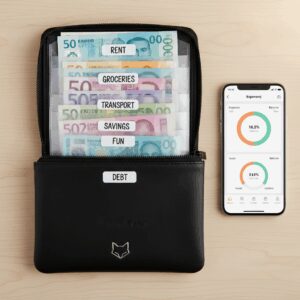
- One page per shared “space” (Rent, Groceries, Travel, Emergency Fund)
- A simple habit tracker next to each goal: checkboxes for each month funded
Building the Actual Workbook: Page-by-Page Blueprint
Here’s a sample structure you can use whether you’re designing your own planner in a notebook, buying a template, or publishing a commercial workbook.
Section 1: Money stories and expectations
Unequal incomes often come with unequal money baggage: shame, pride, fear.[1][3] Start with prompts:
- “Growing up, money in my family was…”
- “I feel most stressed about money when…”
- “In this relationship, I worry that money might make me feel…”
This aligns with expert advice to anchor budgeting talks in “dreams & goals” rather than blame.[3]
Section 2: Numbers overview
- Income snapshot pages for each partner
- Debt + retirement position pages
- Shared vs. personal expenses map
Section 3: Choose your system
- Proportional split worksheet
- Hybrid split worksheet
- Needs vs. goals split worksheet
- A “Decision Page” where you literally sign off on the method for the next 3–6 months
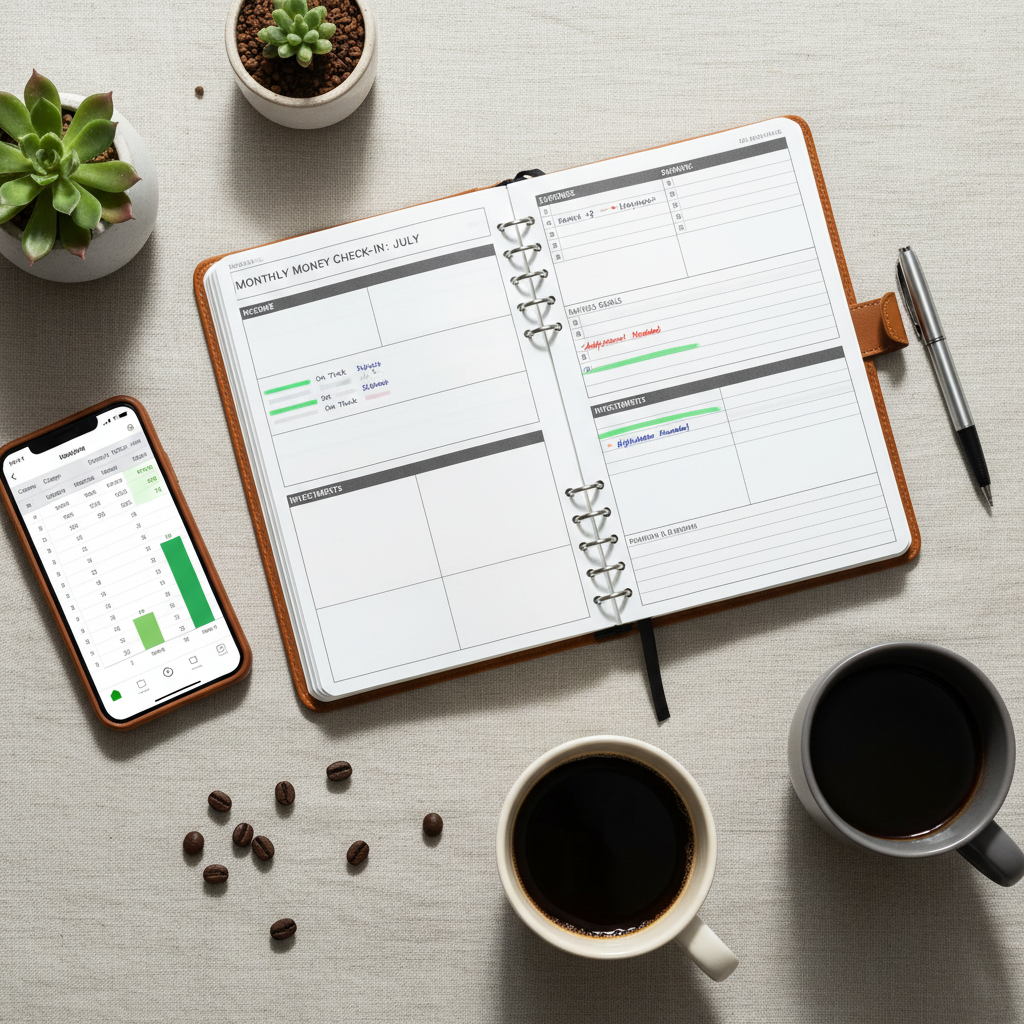
Section 4: Monthly spread
Each month, include:
- Projected vs. actual income for each partner
- Shared expense summary with each person’s target contribution
- Automatic transfer checklist (e.g., “1st of month: both transfer to joint account”)
- Feelings check-in: three short prompts about fairness, stress, and gratitude
Section 5: Quarterly reset
Income changes, debts get paid off, one partner might take a career break. Your planner should expect this. Every three months, include:
- “Has either income changed by 10% or more?”
- “Do we still agree this split feels fair?”
- “What’s one shared goal we want to prioritize next?”
Where Products & Templates Fit In (And How to Choose One Fast)
If you want something ready-made instead of building from scratch, look for:
- Unequal-income focus: Titles or descriptions mentioning “unequal incomes,” “bills split calculator,” or “percentage split.”[6]
- Shared + personal structure: Not just a generic household budget, but explicit “yours / mine / ours” sections.
- Goal tracking: Emergency fund, debt pay-down, and retirement catch-up pages or tabs.[3][5]
On Etsy, unequal-income couples tools typically range from around $5–$20 for digital spreadsheets and printables, with higher-ticket Notion dashboards sometimes running $25–$40 depending on complexity and bundled coaching content.[6] Seeing that price anchor makes a $7–$12 targeted couples workbook or template feel like a low-risk upgrade compared to DIY frustration.
Next Steps: Put a System in Place This Week
If you’ve been stuck in vague “what’s fair?” arguments, you don’t need another theoretical conversation—you need a written, shared system. Here’s a simple 7-day action plan you can drop straight into your planner:
- Day 1–2: Fill out income and debts pages separately, then compare.
- Day 3: Define shared vs. personal categories together.
- Day 4: Test the proportional split worksheet with your real numbers.
- Day 5: If needed, adjust to a hybrid or needs-vs-goals model.
- Day 6: Choose one system for the next 3 months and sign your Decision Page.
- Day 7: Set up your joint account transfers or spreadsheet based on that decision.
The real win isn’t finding the mathematically perfect formula. It’s having a planner that makes your agreement visible, repeatable, and easy to tweak—so you can spend less time debating who pays for what and more time building a life that feels fair to both of you.
Call to action: Before your next bill cycle hits, pick one concrete tool—a couples-focused Google Sheets template, a Notion dashboard, or a printed workbook—designed around unequal incomes. Set aside one evening this week to walk through the pages together and lock in your “fairness system” for the next three months. Your future arguments (or lack of them) will tell you it was worth it.
Unlock Full Article
Watch a quick video to get instant access.