
Bundle Smarter, Not Just Cheaper: 7 Stackable Moves That Can Slash Your 2025 Home & Auto Bill

Bundling your home and auto with one insurer is no longer the secret hack it used to be—it’s the starting line, not the finish line. In 2025, base premiums are rising, weather losses are up, and carriers are getting pickier. Yet shoppers who know how to stack multiple discounts on top of a bundle are still shaving hundreds off their annual bill.
Think of your bundle as the foundation. The real savings come when you layer in telematics, smart-home devices, safe-driver perks, billing choices, and multi-vehicle discounts in a deliberate way.
Why “Just Bundling” Isn’t Enough in 2025
Most big insurers now advertise bundle savings: Allstate promotes up to 25% off when you bundle home and auto online, while Liberty Mutual says new customers who switch and bundle save over $950 per year on average.[6][3] In California, State Farm’s bundle discount reaches around 26%, with Allstate at about 20% and Travelers at roughly 11%.[1]
Those are meaningful numbers—but here’s the catch: that’s typically just one discount category on your policy. Smart shoppers are stacking:
- Bundle / multi-policy discounts
- Telematics or usage-based programs
- Smart-home and home security device credits
- Safe-driver and claim-free discounts
- Autopay, EFT, and paperless billing
- Loyalty and multi-car/multi-property discounts
Do it right, and you’re not chasing 10–20% off a single line—you’re engineering a compounded reduction on the entire household insurance spend.

Step 1: Treat Your Bundle as the “Anchor” Discount
Start by making the bundle work as hard as possible, then layer everything else on top.
Shop the bundle, not just the brand
In some states, the cheapest bundle is not the company with the biggest percentage discount, but the one with the best combined premium after discounts. For example, a 26% bundle break at one carrier could still cost more in raw dollars than an 11% discount at another if their base rates differ.[1]
Action steps:
- Get side-by-side bundle quotes from at least 3–4 carriers (e.g., Allstate, GEICO via its agency partners, Liberty Mutual, Travelers, State Farm).[6][4][3][5]
- Compare the total annual cost after all automatically-applied discounts—not just the advertised bundle percentage.
- Ask explicitly: “What additional discounts could apply if I enroll in telematics, add smart-home devices, go paperless, or add more vehicles?”
Quick benchmark examples (for context)
Recent analyses show that in California, average annual bundle costs can range from roughly $1,892 with Allstate to over $3,000 with some competitors.[1][5] AAA advertises that some new customers report saving $600+ per year when switching and bundling home and auto.[2] Use numbers like these as negotiation leverage when you talk to agents.
Step 2: Stack a Telematics or Usage-Based Program on Top
Telematics programs monitor your driving via a mobile app or plug-in device and reward low mileage, smooth braking, and off-peak driving. Most big carriers now heavily incentivize this.
Typical programs and incentives (examples; specifics vary by state):
- Progressive Snapshot: Up to around 30% for the safest drivers; often includes an initial participation discount.
- Allstate Drivewise: App-based, offering ongoing cash-back style rewards and safe-driving savings.
- Liberty Mutual RightTrack: Promotes potential savings of up to about 30% for consistently safe driving.
Psychology tip: insurers love behavior they can measure. In a high-loss year, being in a telematics program signals you’re actively managing risk, which can help offset rising base rates.
Immediate actions:
- When quoting your bundle, ask: “If we enroll all drivers in your telematics program, what’s the realistic savings range based on people like us?”
- Enroll the safest drivers first (commuters with predictable routes, low-mileage drivers, remote workers).
- Set household rules: no phone use while driving, avoid late-night trips, keep braking and acceleration smooth for the first 60–90 days while the discount is being calibrated.
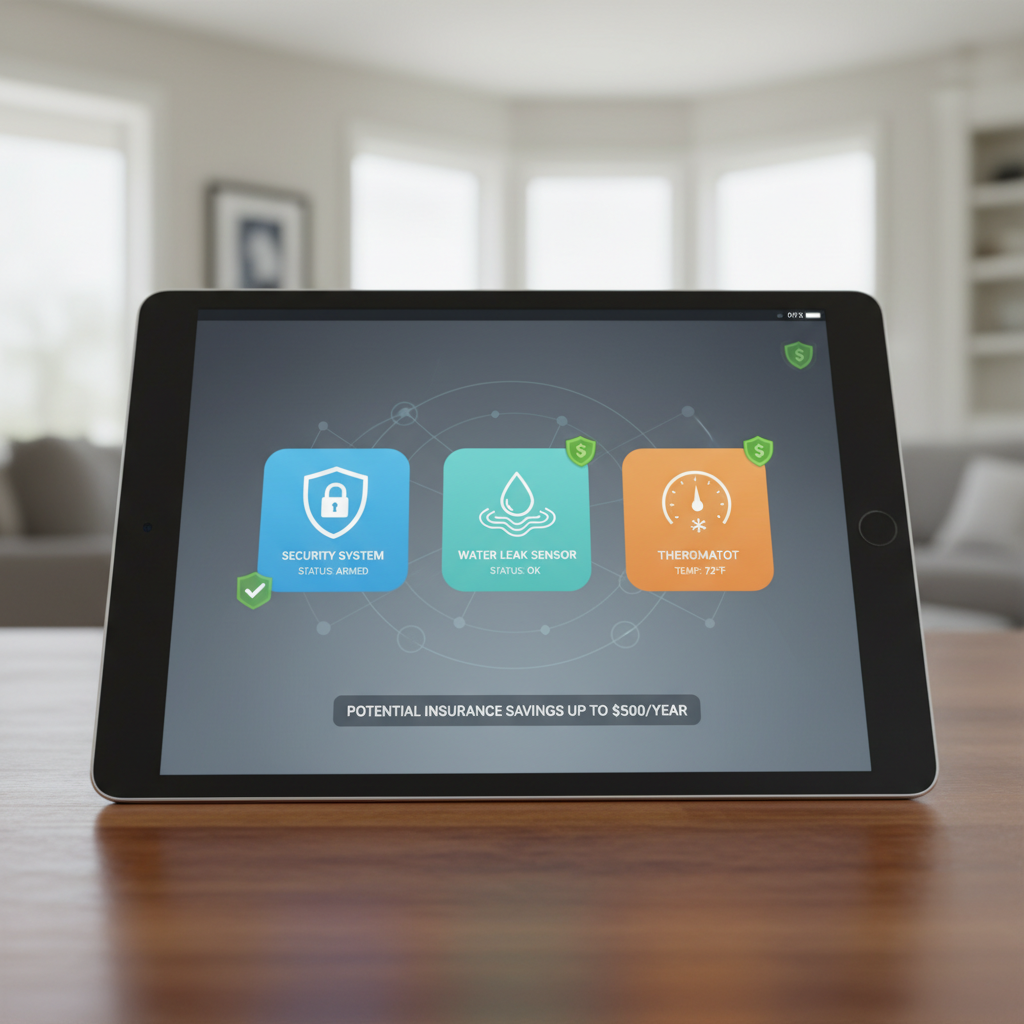
Step 3: Turn Your House Into a Discount Engine with Smart Tech
Insurers increasingly price based on risk-prevention tech in your home. That means you can stack device-specific credits on top of a home-and-auto bundle.
Devices that often earn credits
- Monitored security systems: ADT, Vivint, Ring Alarm Pro (often $10–$30/month monitoring).
- Smart leak detectors: Flo by Moen Smart Water Monitor & Shutoff (commonly in the $400–$600 installed range), or Wi-Fi leak sensors from brands like Honeywell.
- Smart smoke/CO alarms: Google Nest Protect (~$120–$140 per unit), or hard-wired interconnected alarms.
Many carriers offer 5–10% credits on the home policy for monitored security, and smaller but still meaningful credits for things like leak and freeze sensors. When combined with a bundle discount, that can shave another $50–$200 per year off premiums for an average home, depending on location and limits.
Stacking playbook:
- Before buying devices, ask your agent which brands and monitoring setups qualify and how much you’ll save.
- Install and keep receipts, serial numbers, and proof of professional monitoring if applicable.
- Send documentation immediately and confirm the credit appears on your next declarations page—not just at renewal.

Step 4: Combine Safe-Driver, Claim-Free, and Multi-Car Discounts
Safe-driver and claim-free discounts are often separate from telematics, and multi-car discounts stack on top if you insure more than one vehicle.
Examples of what carriers commonly advertise:
- Accident-free for 3–5 years can trigger a safe-driver or claim-free tier.
- Insuring two or more vehicles with the same carrier can add another multi-car discount to the auto side.
Optimization moves:
- Put as many household vehicles as possible on the same policy to fully unlock multi-car savings.
- Ask whether older tickets or small claims are still affecting your rate; if they’re about to age off, time your quote shopping around that date.
- If someone in the household has at-fault accidents or DUIs, ask your agent whether it makes sense to separate that driver onto a different carrier or policy so they don’t dilute your best discounts.
Step 5: Say Yes to the “Easy” Discounts (Autopay, EFT, Paperless)
These feel small, but stacked together they can be the equivalent of one or two ‘free’ coverages.
Commonly available perks:
- Autopay/EFT discount: Some carriers give a small percent off for automatic electronic payments.
- Paperless billing: Email documents and online account access often qualify you for a modest credit.
- Pay-in-full: Paying the 6-month or 12-month premium up front can cut installment fees and sometimes unlock a small additional discount.
Combined, these might only be worth, say, $50–$150 a year. But when layered on top of bundle, telematics, smart home, and multi-car, they can be the difference between “good savings” and “why didn’t I do this sooner?”
Step 6: Leverage Loyalty, But Don’t Let It Handcuff You
Many insurers offer loyalty credits or tiered benefits the longer you stay—accident forgiveness, deductible rewards, or small percentage loyalty discounts. The trap is staying put while your base rate quietly creeps up.
How to use loyalty without overpaying:
- Every 12–24 months, “force” your current carrier to compete by getting fresh bundle quotes elsewhere.
- Tell your existing agent what competing carriers are offering—especially if you see published average bundle savings like Liberty Mutual’s $950 or AAA’s $600+ reports—and ask if they can match or beat it.[3][2]
- If rates spike after a claim or a company exits your state, treat it as a trigger to rebuild your entire stack with a different carrier.
Step 7: A Realistic Stacking Scenario for 2025
Here’s how this can look in practice for a typical homeowner with two cars:
- Base, un-discounted combined premium quoted across separate carriers: $4,200/year.
- Home & auto bundle with a competitive carrier: brings it to roughly $3,400 (about 19% off).
- Telematics enrollment for both drivers: another realistic 10–15% off the auto portion—say $250–$350/year.
- Smart-home discounts (monitored security + leak sensors): $100–$200/year off the home side.
- Multi-car + safe-driver tiers: $200–$300/year combined.
- Autopay + paperless + pay-in-full: $75–$150/year.
End result: your effective annual cost might land in the $2,400–$2,700 range instead of $4,200—without cutting essential coverage. That’s the power of stacking.

5-Point Checklist to Start Stacking This Week
1. Audit your current setup
Pull your latest home and auto declarations pages and highlight every discount line. If you don’t see telematics, smart-home, autopay, or multi-car mentioned, you probably have untapped savings.
2. Decide if you’re willing to switch carriers
If your current carrier won’t offer modern discounts or is hiking rates sharply, note that major competitors (Allstate, Liberty Mutual, GEICO via its agency partners, AAA, Travelers, State Farm, Farmers, USAA for eligible members) actively market bundle and multi-policy savings in 2025.[6][3][4][2][5][7]
3. Get at least three “stack-aware” quotes
When you request quotes, use language like: “Assume I will bundle home and auto, enroll in telematics, use autopay and paperless billing, and add basic monitored security. What does my total annual price look like?”
4. Invest strategically in devices that pay for themselves
Compare the cost of a smart water shutoff or monitored security against your projected annual premium credits. If a $400–$600 device knocks $100–$150 off your premium and lowers your risk of a big claim, you’re ahead financially and better protected.
5. Calendar a yearly “insurance optimization day”
Once a year, review your driving patterns, new devices, claims history, and rate changes. Adjust your stack, re-quote if necessary, and make sure every discount you qualify for is actually being applied.
Your Next Move: Don’t Wait for Your Renewal Notice
Renewal is when most people finally look at their premiums—and by then, rate increases are already baked in. If you want to pay what the most proactive households are paying in 2025, you need to build your stack before your next renewal hits.
Right now, you can:

- List every discount you’re currently getting—and every one you’re missing.
- Contact your agent or three competing carriers and ask for bundle-plus-stack quotes.
- Pick one or two smart-home or billing changes you can implement in the next 30 days.
You don’t control the weather, market losses, or state-level rate filings. But you do control how aggressively you stack the discounts that still exist. Bundle smarter—not just cheaper—and let your insurer reward every smart move you make.
Unlock Full Article
Watch a quick video to get instant access.