Think You’re “Fully Covered” on Your Bike? The 2025 Reality Check Every Rider Needs Before Their Next Renewal
If you assume your bike is safe just because your policy says “full coverage,” you’re exactly the rider most at risk in 2025.
That label sounds comforting, but in today’s world of spiking thefts, higher repair costs, and more distracted drivers, it’s dangerously easy to be underinsured while believing you’re protected.
Here’s the truth: “Full coverage” is not a legal or standardized term. In practice, it usually means a bundle of liability + collision + comprehensive—and not much more.[2][4][9] Everything you care about (your custom parts, medical bills, lost wages, gear, even a total loss payout that actually lets you replace your bike) is either an optional add-on, limited, or missing entirely unless you build it in on purpose.[1][3][5]
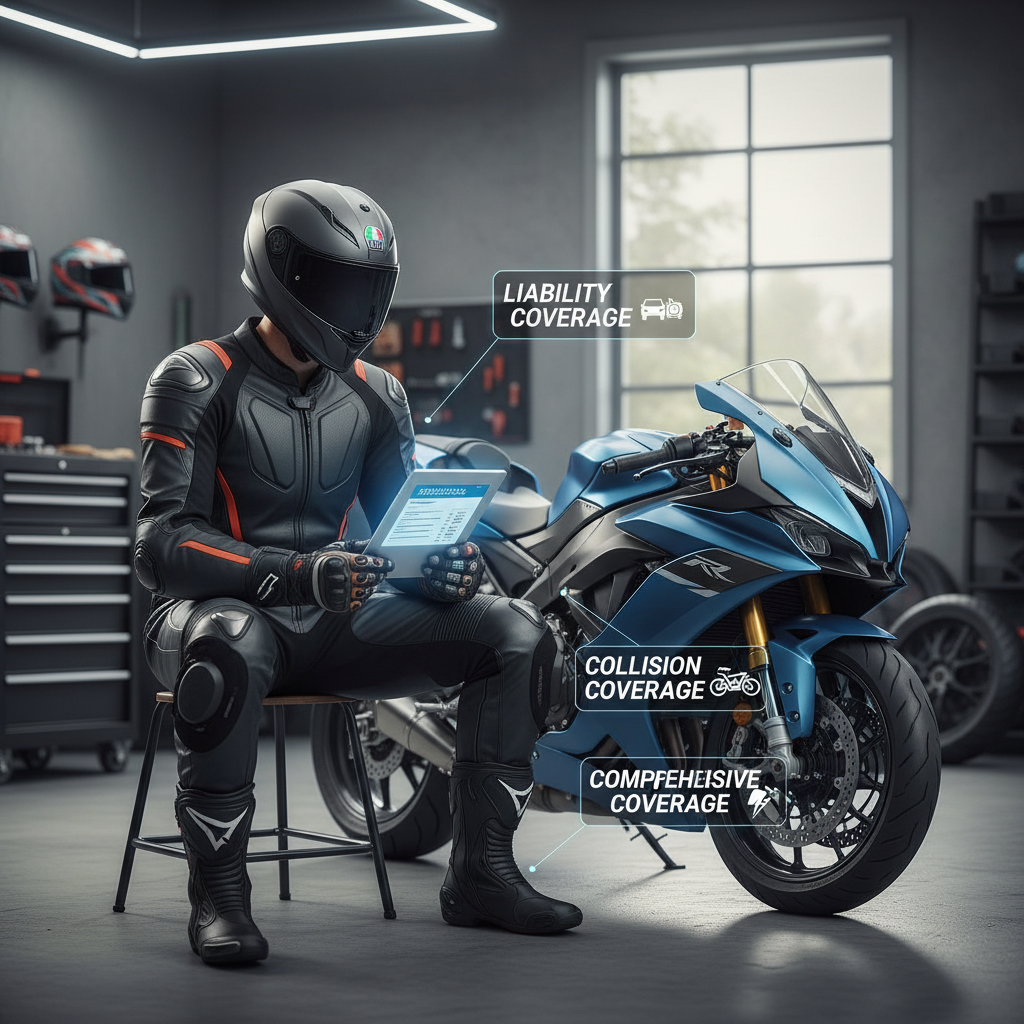
Image idea (after_intro): A rider in full gear looking over a policy on a tablet in a garage with a customized bike, visual overlays highlighting different coverage gaps (helmet, pipes, electronics).
The 2025 Landscape: Why “Set-It-and-Forget-It” Motorcycle Insurance Is Riskier Than Ever
Before you look at coverages, understand the environment you’re riding in. Insurers and agents are pricing policies for a very different reality than even a few years ago:
- Premiums are climbing. Full coverage motorcycle insurance averages about $33 per month / $399 per year nationally, but ranges from around $18 per month in low-risk states to $69 or more in high-risk ones.[7][10]
- Bike type matters more than ever. Sport bikes can cost about 3.5× more to insure than cruisers because of higher claim severity and theft rates.[7]
- Financed bikes are forced into “full coverage.” If you have a loan or lease, your lender will typically require liability, collision, and comprehensive—no exceptions.[2][4][6]
- Customization is exploding. Riders are putting thousands into paint, chrome, audio, and performance parts, while many policies only include $2,000–$3,000 of default accessory coverage unless you buy more.[1][3]
That means a generic “full coverage” policy built for a stock commuter might be wildly mismatched to a $25,000 bagger with $8,000 in upgrades or a financed supersport in a theft-heavy metro area.
What Insurers Usually Mean by “Full Coverage” in 2025
Most carriers, aggregators, and comparison sites use “full coverage” as shorthand for three core protections bundled together:[2][4][6][9]
1. Liability (Required Almost Everywhere)
This is the part states care about—and the part most riders accidentally lowball.
- Bodily Injury Liability: Pays medical bills and lost wages for people you injure if you’re at fault.[1][5]
- Property Damage Liability: Pays for damage you cause to cars, buildings, or other property.[1][5]
State minimums can be absurdly low compared to real-world crash costs. Your “full coverage” policy might technically be compliant but leave your personal assets exposed if you cause a serious crash.
2. Collision
Collision pays to repair or replace your motorcycle if it’s damaged in a crash with another vehicle or object—regardless of fault.[1][3][6]
- Example: You clip a guardrail or get cut off and drop the bike; collision responds to the damage to your bike.
- Not covered: Theft, vandalism, weather, or injuries to you.[1]
3. Comprehensive
Comprehensive handles non-collision damage: theft, vandalism, fire, weather (hail, floods, storms), falling objects, and hitting an animal.[1][3][6][8]
- Crucial if you live in a high-theft or severe-weather state or park outdoors.
- Often required by lenders on financed bikes.[2][4]
Put together, these three give you what most marketers and agents casually call “full coverage.” But notice what’s missing: your medical bills, lost income, passengers, high-value custom work, OEM parts, gear, trip costs, and more.[1][5][9]
The Gaps Riders Only Discover After a Claim
This is where riders get burned—assuming the phrase “full coverage” means “everything is covered.” It doesn’t. Here are the most common blind spots:
1. Your Own Injuries & Lost Wages
Standard “full coverage” usually does not include robust medical or income protection for you.
- Medical Payments (MedPay) or Personal Injury Protection (PIP) is often optional and state-dependent. Without it, you’re relying on health insurance (with its own deductibles) or the other driver’s liability—if they’re at fault and properly insured.
- Serious crashes can trigger six-figure medical bills; relying on minimum limits is a major financial gamble.
2. Custom Parts, Paint, and Accessories
Most base policies quietly cap custom parts and accessories at around $2,000–$3,000 unless you buy more.[1][3]
- If you’ve added a $2,500 exhaust, $1,500 wheels, and a $3,000 audio setup, you’re already beyond typical built-in limits.
- Custom Parts & Accessories (CPE) or Accessory Coverage can usually be increased to match your investment.[1][3]
3. Actual Cash Value vs. Agreed Value
Unless you’ve chosen otherwise, your bike is likely insured at actual cash value (ACV)—what it’s worth today after depreciation—not what you paid.
- Some insurers, like Harley-Davidson Insurance, offer agreed value coverage on certain models, where you and the insurer agree on a value upfront.[3]
- Many carriers also offer total loss coverage for a new motorcycle, paying the bike’s MSRP for a brand-new replacement if it’s totaled within a set timeframe.[1]
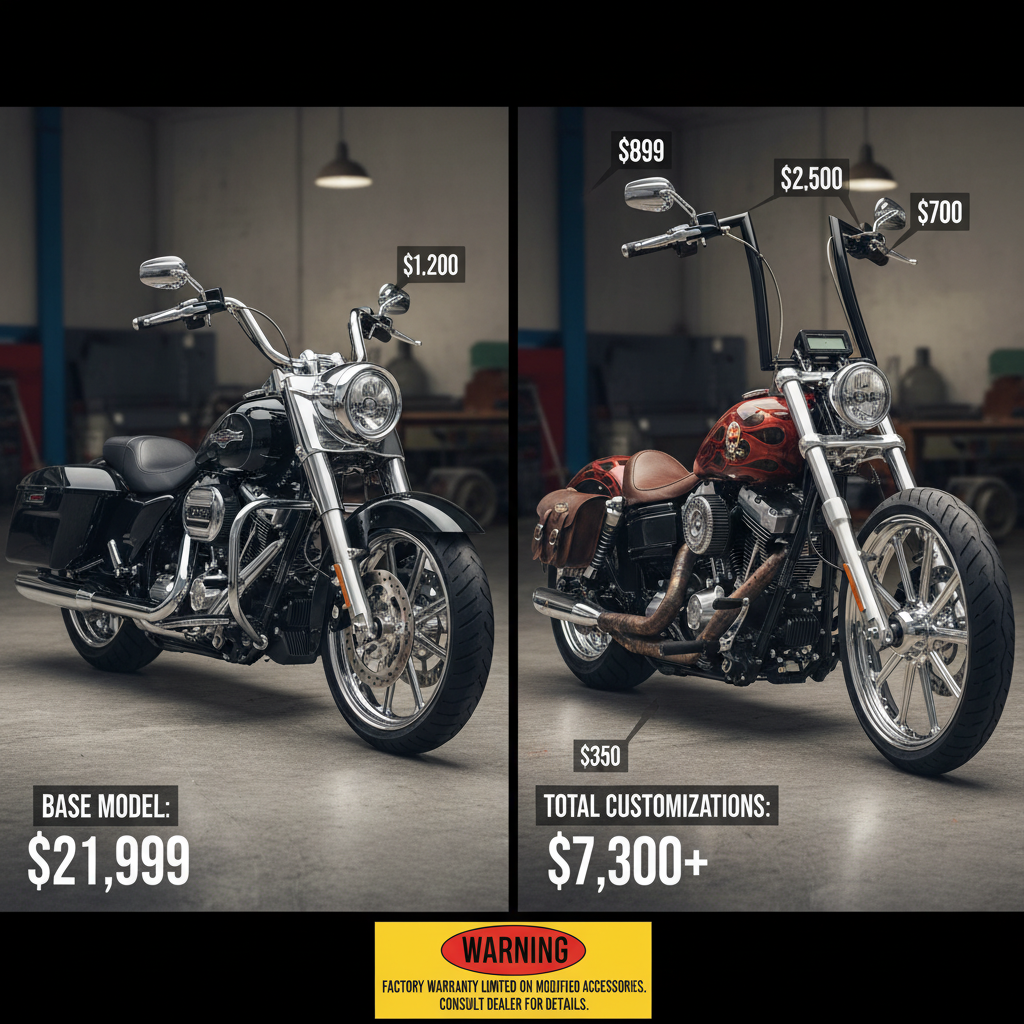
Image idea (middle): Side-by-side graphic: left shows a stock cruiser; right shows same bike fully customized with price tags on upgrades and a small “$3,000 default accessory cap” warning.
4. OEM vs. Aftermarket Parts
Basic policies may allow cheaper aftermarket parts for repairs. If you care about factory quality and bike value, look for:
- OEM Parts Coverage that specifies repairs must use original manufacturer components.[1]
5. Passengers, Gear, and Trip Costs
High-mileage tourers and two-up riders have additional risk points:
- Guest Passenger Liability: Often included but not always, and limits can be low.[1]
- Safety Apparel Coverage: Reimburses helmets, jackets, gloves, etc., after a covered loss.[1][3]
- Roadside Assistance & Trip Interruption: Covers towing, fuel, and sometimes hotel/meals if you’re stranded far from home.[1]
Real-World Examples: How Current Products Package “Full Coverage”
To see how this plays out in 2025, look at how popular providers structure their offerings and pricing:
- Progressive Motorcycle Insurance is known for broad coverage bundles including liability, collision, comprehensive, and aftermarket parts coverage at competitive rates.[3] In many states, a typical full coverage package on a standard bike can fall in the $300–$500/year range, depending on limits and deductibles.[4][7]
- Harley-Davidson Insurance markets itself heavily to cruiser and touring riders, combining liability, collision, comprehensive, accessory coverage, and agreed value options for certain models.[3] In California, full coverage through Harley-Davidson can run around $42 per month, among the cheaper options highlighted in 2025 comparisons.[3]
- Across carriers, recent analyses place nationwide full coverage motorcycle insurance at an average of about $364–$399 per year, depending on methodology and coverages compared.[4][7][10]
These numbers are anchors: if your quote is dramatically lower, it might be because limits are bare minimum and add-ons are stripped out. If it’s far higher, it may be due to bike type, state, or a prior claims/violation history.[7][8]
How to Build a Truly Complete Motorcycle Policy in 2025
Instead of asking, “Do I have full coverage?” use this 7-step checklist to engineer the protection you actually need:
Step 1: Set Liability Limits Like You Have Something to Lose
Skip state minimums. Consider higher combined single limits or at least 100/300/50 (or better), especially if you own a home, have savings, or frequently ride in dense traffic.[1][5]
Step 2: Match Collision & Comprehensive to Your Bike’s Real Risk
- If your bike is financed, these are non-negotiable.[2][4]
- For older, low-value, fully paid-off bikes, it may be rational to drop collision but keep comprehensive if theft and weather are major risks.[8]
Step 3: Add Medical Payments or PIP Where Available
Layer MedPay/PIP on top of health insurance to cushion deductibles and co-pays. This is especially useful if you ride often, commute daily, or ride group events where crash probability rises.
Step 4: Inventory and Insure Your Custom Work
Take photos and keep receipts for all non-stock parts. Then:
- Increase Custom Parts & Accessories or Accessory Coverage to match your true investment (often well beyond the default $2,000–$3,000).[1][3]
Step 5: Ask About Agreed Value and Total Loss Options
If you have a new, high-value, or collectible bike:
- Request agreed value or stated value quotes, especially on customs, vintage, or limited editions.[1][3]
- For new bikes, look for total loss replacement that pays MSRP for a brand-new bike if totaled in the first few model years.[1]
Step 6: Lock In OEM Parts Coverage if You Care About Resale
Ask your carrier or agent explicitly whether repairs will use OEM parts and, if not, what it costs to upgrade to OEM-only coverage.[1]
Step 7: Layer in Roadside, Trip Interruption, and Gear Coverage
These are inexpensive but high-ROI for touring riders:
- Roadside Assistance for towing and basic emergencies.[1]
- Trip Interruption for lodging and meals if you break down away from home.[1]
- Safety Apparel Coverage to replace helmets and riding gear after a covered crash.[1][3]
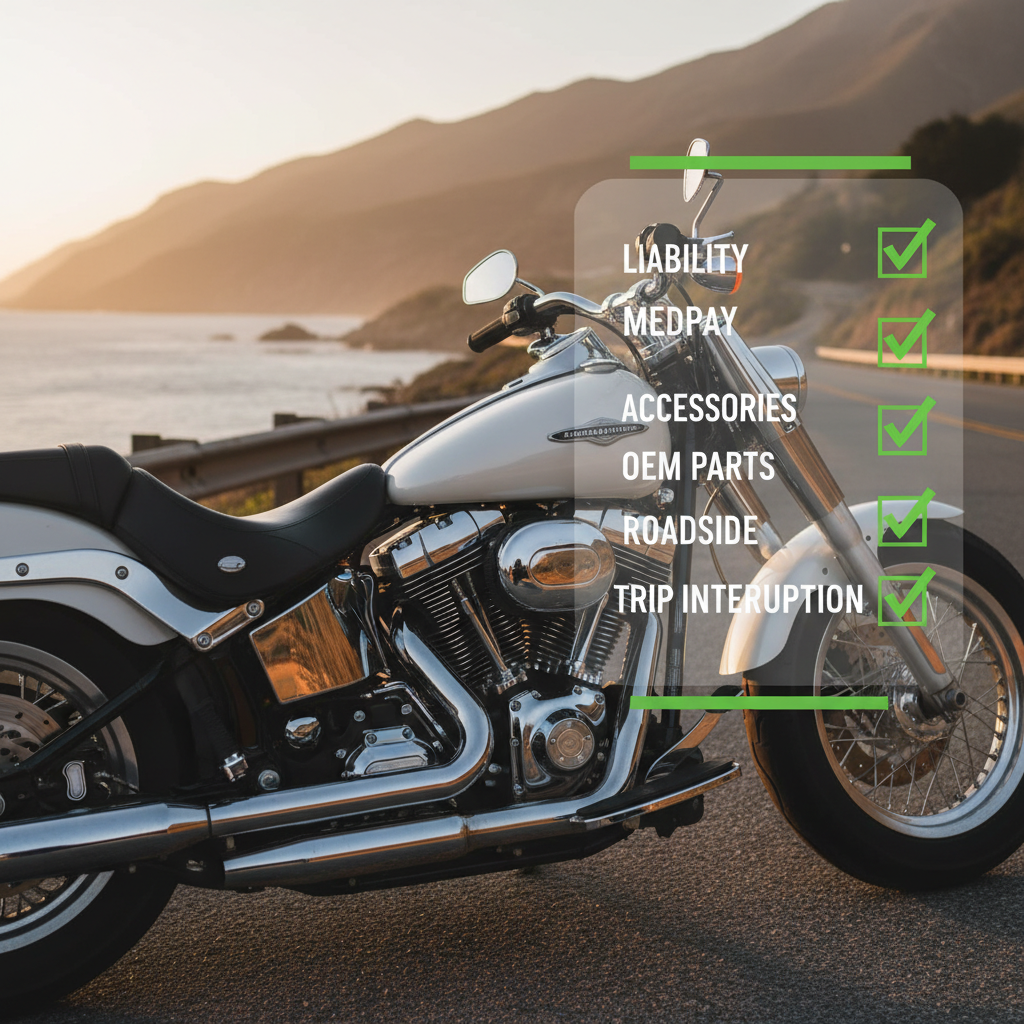
Image idea (before_conclusion): Visual checklist overlay on a bike, with ticks next to liability, med pay, accessories, OEM, roadside, and trip interruption to reinforce the step-by-step build.
Action Plan Before Your Next Ride (or Renewal)
Most riders don’t discover their gaps until a loss—by then, it’s too late to fix. To avoid that, take these actions within the next 24–48 hours:
- Pull your current declarations page and circle: liability limits, collision/comprehensive deductibles, custom parts/accessory limits, and any MedPay/PIP or guest passenger coverage.
- Compare your coverage to the 7-step checklist above. Anywhere you see a mismatch between what you think you have and what’s listed, highlight it.
- Get at least 2–3 updated quotes from carriers known for motorcycle coverage (e.g., Progressive, Harley-Davidson Insurance, AAA-affiliated agencies, independent brokers).[1][3][6][9]
- Use price anchoring smartly: If your current full coverage is around $399/year with thin limits,[7][10] see what it costs to raise liability, add MedPay, and increase accessory coverage. Many riders are surprised that real upgrades cost less than a single new tire.
Don’t wait until the next theft spike or spring rate increase—insurers are already pricing for higher risk. Every renewal you sign without dissecting “full coverage” is a bet that nothing major will happen before you upgrade your policy.
Next step: Before your next ride, open your policy, run it through the checklist, and talk to a licensed agent or broker about plugging the gaps. Your bike, your money, and your family will all be better protected when “full coverage” finally means what you think it does.
Unlock Full Article
Watch a quick video to get instant access.