Marketplace vs Off-Exchange: Which Private Health Insurance Actually Saves Self-Employed People Money in 2026?
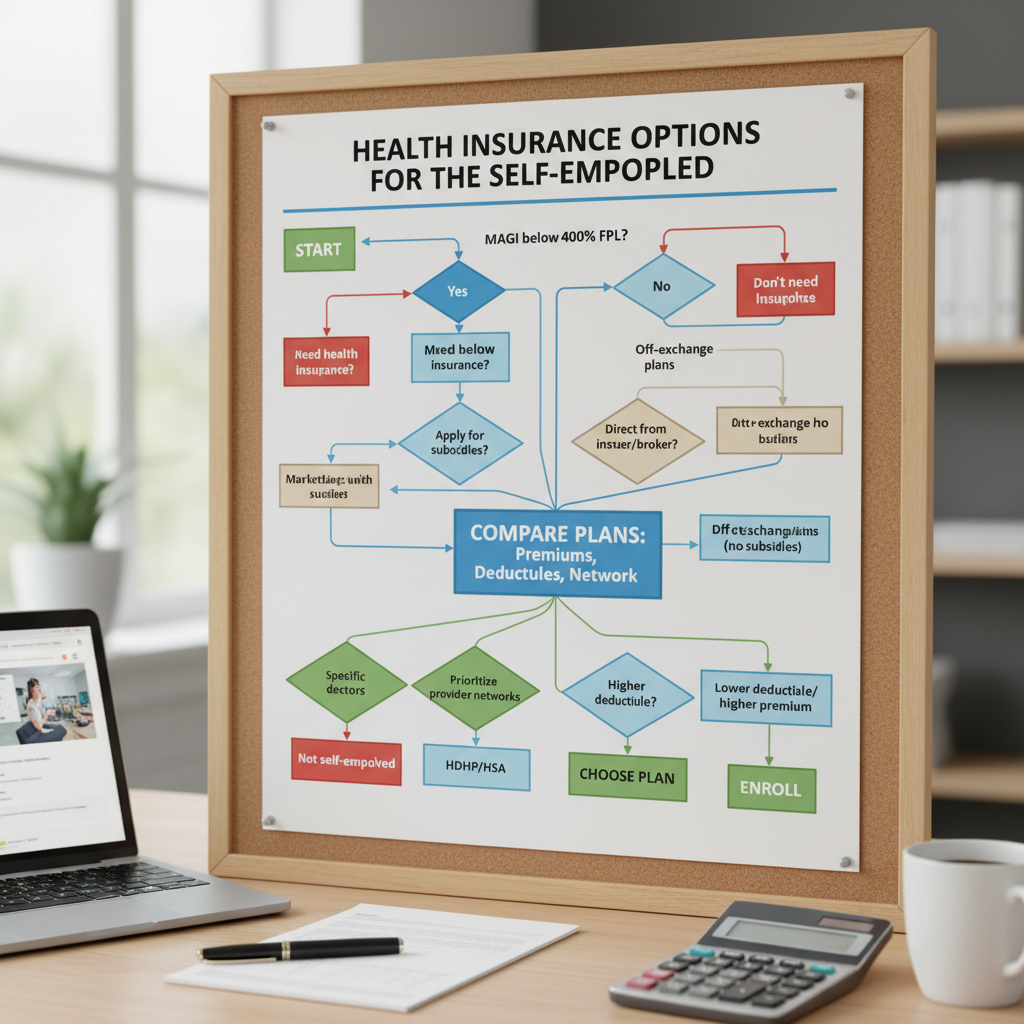
The Self-Employed Health Insurance Crisis: Why 2026 Changed Everything
If you’re self-employed and earning just above the subsidy cutoff, 2026 is the year your health insurance costs likely exploded. Income-based subsidies that made Marketplace plans affordable are phasing out, leaving thousands of independent contractors and small business owners facing a brutal choice: pay full Marketplace premiums (often $731–$1,451 monthly for a 52-year-old) or explore alternatives that actually fit your budget.
The problem? Most self-employed people don’t realize they have options beyond the government Marketplace. There’s an entire world of private health insurance—both on-exchange and off-exchange—that can cost 40–60% less per month while covering the same doctors and hospitals.
Here’s what you need to know to make the right decision before your next renewal.

On-Exchange (Marketplace) Plans: The Guaranteed Safety Net
ACA Marketplace plans purchased through Healthcare.gov or state exchanges come with ironclad protections. You cannot be denied coverage for any reason, including pre-existing conditions. These plans must cover essential health benefits—hospital stays, maternity care, prescriptions, preventive services—and cap your annual out-of-pocket costs.
For 2026, these caps are steep: $10,600 for individuals and $21,200 for families. But here’s the reality for self-employed earners:
Marketplace deductibles are typically $7,500 to $9,000 per person, meaning you pay the full cost of care until hitting that threshold. Many ACA networks are HMO-only, restricting you to in-state doctors and requiring referrals. And without subsidies, the monthly premiums become financially unsustainable for most independent earners.
Marketplace plans make sense if you have major health conditions, expensive prescriptions, or anticipate significant medical care. The guaranteed coverage and essential health benefits justify the cost. But if you’re generally healthy? The math stops working.
Off-Exchange Plans: The Hidden Alternative Most Self-Employed People Miss
Off-exchange plans are purchased directly from insurance carriers or through brokers—not through the government Marketplace. This distinction matters because it changes everything about cost, speed, and flexibility.
There are two types of off-exchange plans:
1. ACA-Compliant Off-Exchange Plans
These follow all ACA rules (essential health benefits, no pre-existing exclusions, guaranteed issue) but are sold outside the Marketplace. Since subsidies aren’t involved, enrollment takes under 10 minutes with minimal identity verification. Carriers like Oscar have more flexibility in what they offer—for example, Oscar partnered with Hy-Vee grocery stores to include free onsite primary care for members.
You still get full ACA protections, but with faster enrollment and sometimes creative perks unavailable on-exchange.
2. Medically Underwritten Private Plans
These are the real cost-savers—but with a critical catch. Medically underwritten plans require you to answer health questions and provide medical history. The insurance company then decides whether to approve you. If approved, premiums can be close to half the cost of full-price Silver Marketplace plans.
For a 52-year-old self-employed person, private PPO plans average $350–$500 monthly versus $731–$1,451 for Marketplace coverage. That’s a potential savings of $3,000–$13,000 per year.
But here’s the trade-off: you must be healthy enough to qualify. If you have ongoing medical conditions or expensive prescriptions, you’ll likely be denied and forced back to the Marketplace anyway.
The Cost Comparison That Changes Everything
Let’s look at actual numbers for a 52-year-old self-employed consultant:
Marketplace Plan (Full Price, No Subsidies):
– Monthly Premium: $731–$1,451
– Annual Cost: $8,772–$17,412
– Deductible: $9,000–$15,000
– Doctor Visits: Covered only after deductible
– Accident Coverage: None
– Network: In-state HMO only
– Annual Out-of-Pocket Max: $10,600
Private PPO Plan:
– Monthly Premium: $350–$500
– Annual Cost: $4,200–$6,000
– Deductible: $3,000–$7,000
– Doctor Visits: First-dollar coverage (no deductible)
– Accident Coverage: $20,000 per accident ($250 responsibility)
– Network: Nationwide PPO access
– Tax Write-Off: 100% deductible for self-employed
For many self-employed people, the private PPO covers the same doctors and hospitals as Marketplace plans while costing 40–60% less monthly. The lower deductible also means you actually use the coverage without hitting a financial wall.
Who Should Stay on the Marketplace (And Why)
Not everyone should jump to off-exchange plans. Stay on the Marketplace if:
• You have major health conditions or expensive prescriptions
• You want guaranteed ACA coverage with zero underwriting
• You’re planning significant medical procedures next year
• You value the certainty of standardized essential health benefits
• You still qualify for any subsidy amount
The Marketplace may cost more, but it’s the appropriate choice if you need comprehensive protection without health-based denials.
Who Should Explore Off-Exchange Options
Off-exchange plans work best if:
• You’re self-employed and generally healthy
• You’re losing subsidies and facing full Marketplace premiums
• You want meaningful monthly savings (potentially $300–$900)
• You’re comfortable with a health questionnaire application
• You need nationwide PPO access (frequent travelers, snowbirds)
• You want to maximize tax deductions
If you qualify for medically underwritten plans, the savings are often dramatic enough to justify exploring the option with a broker.
The 2026 Landscape: What Changed and Why It Matters
In 2026, eight major changes took effect reshaping Marketplace coverage. Income-based subsidies that made plans affordable are now phasing out for higher earners. Simultaneously, more plans now work with Health Savings Accounts (HSAs), giving you tax-advantaged ways to save for healthcare costs.
This creates a window of opportunity: self-employed people can now compare true apples-to-apples between Marketplace and private options, with HSA-eligible plans on both sides.
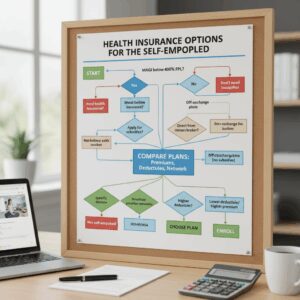
How to Make Your Decision: A Step-by-Step Guide
Step 1: Assess Your Health Status
Are you generally healthy with no major ongoing conditions? If yes, off-exchange options may work. If you have chronic conditions, stay Marketplace.
Step 2: Calculate Your True Marketplace Cost
Don’t just look at premiums. Add deductibles, copays, and out-of-pocket maximums. A $500/month plan with a $9,000 deductible costs far more than a $350/month plan with a $5,000 deductible.
Step 3: Get Pre-Qualified for Off-Exchange Plans
Work with a broker to understand what you’d qualify for. Many brokers offer free consultations and can show you actual plan options and pricing within minutes.
Step 4: Compare Networks
Make sure your doctors and preferred hospitals are in-network for any plan you consider. A cheap plan is worthless if it doesn’t cover your providers.
Step 5: Review Tax Benefits
Self-employed people can deduct 100% of health insurance premiums. Factor this into your true cost calculation.
The Bottom Line: You Have More Options Than You Think
In 2026, the gap between Marketplace and private PPO plans has widened dramatically. For healthy, self-employed earners losing subsidies, the choice is increasingly clear: explore off-exchange options and potentially save thousands annually while maintaining quality coverage.
But this requires action. Don’t passively accept full Marketplace premiums. Speak with a broker, get pre-qualified, and compare actual numbers. The difference could be $300–$900 monthly—money that stays in your business instead of going to insurance companies.
Your health insurance choice is one of the biggest financial decisions you make as self-employed. Make it deliberately, with current information and actual quotes in hand.
Unlock Full Article
Watch a quick video to get instant access.