Self-Employed in 2025? How to Stack Tax Breaks to Cut Your Private Health Insurance Bill
Self-Employed in 2025? How to Stack Tax Breaks to Cut Your Private Health Insurance Bill
If you’re self-employed in Canada, you’re likely paying premium prices for health insurance—sometimes 30-40% more than your employed counterparts. But here’s what most self-employed professionals don’t realize: the Canadian tax system offers multiple overlapping deductions and credits specifically designed to offset these costs. By strategically combining these tools, you can reduce your real, after-tax cost of private health insurance by thousands of dollars annually.
The challenge? These tax breaks aren’t obvious. They’re scattered across different CRA rules, eligibility requirements, and filing methods. Most self-employed people claim only one benefit when they could be claiming three or four simultaneously. This guide walks you through the exact strategies to maximize your savings.
Strategy #1: The Business Expense Deduction (The Heavy Hitter)
This is your primary weapon against high premiums. If you’re a sole proprietor or partner in a partnership, you can deduct your private health insurance premiums directly as a business expense—not as a medical expense. This is fundamentally different and dramatically more valuable.

Here’s why: When you claim premiums as a business expense, they reduce your taxable business income dollar-for-dollar. If you’re in a 40% marginal tax bracket (common for self-employed professionals earning $80,000+), a $5,000 annual premium costs you only $3,000 in real money after tax savings.
Eligibility requirements:
- You must be a sole proprietor or in a partnership (incorporated business owners cannot use this deduction)
- Your net self-employment income must represent at least 50% of your total income
- Income from other sources must be under $10,000 annually
- Your health plan must qualify as a Private Health Services Plan (PHSP) under CRA rules
Most standard individual health insurance plans from major Canadian providers (Sun Life, Manulife, Blue Cross, Desjardins) qualify as PHSPs. The plan must cover medical services eligible under the Medical Expense Tax Credit—which includes hospitalization, prescription drugs, dental work, vision care, and medical devices.
To claim this deduction, you simply report the premium amount on your business tax return. No threshold applies—you deduct 100% of the premium, regardless of other medical expenses.
Strategy #2: Layer In the Medical Expense Tax Credit for Additional Savings
Even if you claim your premiums as a business expense, you can still claim other out-of-pocket medical expenses through the Medical Expense Tax Credit (METC). This is where most self-employed people leave money on the table.
The METC applies a threshold: you can only claim medical expenses exceeding 3% of your net income or $2,834 for 2025, whichever is less. Once you exceed this threshold, you claim the remainder as a non-refundable tax credit at the federal rate of 14.5%.
Example: If your net income is $80,000, your threshold is $2,400 (3% of $80,000). If you have $8,000 in eligible medical expenses beyond your premiums, you can claim $5,600 ($8,000 minus $2,400). At 14.5%, this generates a $812 tax credit. Multiply this across multiple family members, and you’re looking at $1,500-$2,500 in additional credits annually.
Eligible expenses include prescription medications, dental work not covered by insurance, vision correction, mobility aids, and professional services like physiotherapy or psychology.
Strategy #3: Maximize Coverage for Spouse and Dependents
Self-employed individuals can claim health insurance expenses for spouses, common-law partners, and dependent children on a single family plan. This multiplies your deductions significantly.
If you’re running a family business with your spouse, both partners can potentially claim deductions if each meets the self-employment income threshold independently. A couple earning $60,000 each from their business can deduct two separate health plans—or one family plan with both partners claiming proportional amounts.
For dependents, you can claim their medical expenses even if they’re over 18, as long as they meet the CRA’s definition of dependent (primarily based on your financial support and their net income).
Strategy #4: Choose the Right Insurance Product for Tax Optimization
Not all health insurance plans are created equal for tax purposes. Here’s what to evaluate:
Individual vs. Family Plans: Family plans typically cost 20-30% less per person than individual policies. For a couple, expect to pay $200-350/month for comprehensive family coverage versus $120-180/month per individual plan. The family plan is almost always the better tax strategy.
Plan Type Comparison:
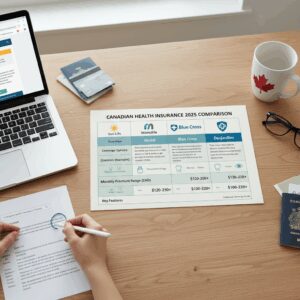
| Plan Type | Annual Premium Range | Deductibility | Best For |
|---|---|---|---|
| Basic Coverage (hospitalization only) | $1,200-$2,000 | Yes (PHSP) | Budget-conscious, young professionals |
| Standard Coverage (hospital + drugs + dental) | $2,400-$4,800 | Yes (PHSP) | Most self-employed professionals |
| Comprehensive Coverage (hospital + drugs + dental + vision + wellness) | $3,600-$7,200 | Yes (PHSP) | High-income earners, families with dependents |
Major Canadian providers and their 2025 offerings:
- Sun Life: FlexCare Individual plans starting at $89/month; comprehensive family plans at $280-350/month
- Manulife: Individual health plans from $95/month; GroupPlus plans for small businesses
- Blue Cross Canada: Provincial variations; typical individual coverage $100-150/month
- Desjardins: Self-employed specific plans with deductible options from $0-$500
- Wawanesa: Competitive rates on individual and family plans, $85-200/month depending on coverage
The strategy: Choose comprehensive coverage with a higher deductible ($500-$1,000) rather than lower deductibles. You’ll save 15-25% on premiums, and the tax deduction offsets the higher out-of-pocket cost. Plus, your spouse and dependents can claim the out-of-pocket expenses separately through the METC.
Strategy #5: Document Everything for CRA Compliance
To claim your deductions without audit risk, maintain meticulous records:

- Keep all premium payment receipts and statements from your insurance provider
- Retain proof of business income (T1 General, business tax return, financial statements)
- Document that your health plan qualifies as a PHSP (check your policy documents)
- For medical expenses, keep receipts, prescriptions, and professional invoices
- Maintain a spreadsheet tracking all medical expenses by category and family member
The CRA audits self-employed individuals at higher rates than employees. Having organized documentation reduces audit risk and ensures you can defend every dollar claimed.
The Real Numbers: How Much Can You Actually Save?
Let’s calculate a realistic scenario for a married couple, both self-employed:
Scenario: Combined household income $120,000; family health insurance premium $4,800/year; additional medical expenses (dental, prescriptions, vision) $3,000/year; marginal tax rate 40%.
Tax savings breakdown:
- Business expense deduction (premiums): $4,800 × 40% = $1,920 in tax savings
- METC on additional expenses ($3,000 – $3,600 threshold = $0, but spouse’s threshold applies): approximately $200-400 in combined credits
- Total annual tax benefit: $2,120-$2,320
- Real after-tax cost of insurance: $2,480-$2,680 instead of $4,800
- Effective savings: 44-56% of premium cost
For high-income self-employed professionals in the 50%+ marginal tax bracket, these savings increase proportionally.
Action Steps: Implement These Strategies This Tax Year
Step 1 (Immediate): Verify your business structure. If you’re incorporated, consult a tax accountant—you’ll need different strategies (Health Spending Accounts or spousal PHSP claims).
Step 2 (This Week): Review your current health insurance plan. Confirm it qualifies as a PHSP by checking your policy documents or contacting your provider. Request a detailed premium breakdown.
Step 3 (Next 2 Weeks): Shop for plans using the comparison table above. Get quotes from at least three providers. Calculate the after-tax cost using your marginal tax rate (higher deductible options often win when you factor in tax savings).
Step 4 (Before Filing Taxes): Compile all medical expense receipts. Use a spreadsheet to categorize by family member and expense type. Calculate your METC claim.
Step 5 (Tax Filing): Work with a tax professional familiar with self-employed deductions. The $200-300 fee for professional preparation easily pays for itself through optimized claims.
Common Mistakes Self-Employed People Make
Mistake #1: Claiming premiums as medical expenses instead of business expenses. This triggers the 3% threshold and reduces your deduction by 50-70%.
Mistake #2: Not claiming spouse or dependent medical expenses. Each family member has their own METC threshold—you can claim for multiple people simultaneously.
Mistake #3: Choosing plans based on premium alone without considering tax impact. A $150/month plan that qualifies as a PHSP is worth far more than a $120/month plan that doesn’t.
Mistake #4: Forgetting to claim dental and vision expenses. Many self-employed people claim their insurance premium but overlook the $2,000-$4,000 in annual dental and vision costs that also qualify for the METC.
The Bottom Line
Self-employed Canadians face higher health insurance costs than employees, but the tax system compensates through multiple deduction and credit mechanisms. By layering the business expense deduction, METC claims, family coverage optimization, and strategic plan selection, you can reduce your real after-tax cost by 40-56%.
The key is understanding that these tools work together. Most self-employed people use one or two; the financially sophisticated use all of them. The difference is thousands of dollars annually.
Start by verifying your business structure and current plan’s PHSP status. Then implement the five strategies outlined above. If you’re uncertain about any aspect, the $200-300 investment in professional tax advice will return itself many times over through optimized deductions.
Your health insurance doesn’t have to drain your business. With the right strategy, it becomes a tax-efficient business expense that costs significantly less than the sticker price.
Unlock Full Article
Watch a quick video to get instant access.