Don’t Get Stuck With a $200,000 Hospital Bill: The 2025 Playbook for Ranking Travel Medical Coverage Like a Pro

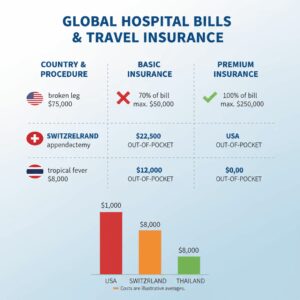
You can book the perfect hotel, obsess over flight prices, and still miss the single decision that protects your entire trip: how you rank and compare medical coverage inside travel insurance plans. In 2025, a medical evacuation can still run over $200,000, and many hospitals abroad won’t even admit you without proof of coverage. That’s why the smart move isn’t just “buy insurance” – it’s systematically comparing medical benefits across providers so you never gamble with your health or your wallet.
The 10‑Minute Medical Coverage Filter: Start With These Non‑Negotiable Numbers
Before you even look at bonuses like lost baggage, you need a hard filter for medical coverage. Think of this as your baseline test: if a plan fails here, you move on immediately.

1. Minimum emergency medical & evacuation limits
Independent comparison platforms like Squaremouth recommend at least $50,000 in emergency medical and $100,000 in medical evacuation for international trips, with higher limits for cruises and remote destinations.[2][1]
But in 2025, many serious travelers quietly anchor much higher, because top plans have pushed limits upward:
- Generali Premium Plan: $250,000 per person for Medical & Dental and up to $1,000,000 for Emergency Assistance and Transportation.[1]
- Generali Preferred Plan: Emergency Assistance & Transportation up to $500,000 per person.[1]
- Specialized medical‑only plans on Squaremouth: often $50,000–$1,000,000 in medical and $250,000–$1,000,000 in evacuation.[2]
Use this simple rule:
• City breaks near home: $50,000 medical / $100,000 evacuation minimum.[2]
• Cruises, safaris, remote islands: Aim for $100,000–$250,000 medical and $250,000–$1,000,000 evacuation.[1][2]
2. Primary vs. secondary medical coverage
Look for whether the plan pays as primary coverage or only after your home health insurance (secondary). Primary coverage can mean:
- Faster claims because you don’t have to chase your domestic insurer first.[2]
- Less risk of disputes between insurers about who pays what.
Many U.S. health plans and Medicare are not accepted abroad or won’t cover evacuation, which is why the U.S. State Department strongly advises travel health insurance.[2] When in doubt, favor primary coverage and confirm this in the policy wording.
Real Plans, Real Prices: How 2025 Products Stack Up on Medical Coverage
To make this concrete, here’s how some widely‑used brands position medical coverage in 2025, based on recent reviews and product pages.[1][2][4]
Snapshot comparison: examples from current providers
| Provider / Plan (Example) | Medical Limit | Evacuation | Indicative Price* | Best For |
|---|---|---|---|---|
| Generali Premium | $250,000 Medical & Dental[1] | Up to $1,000,000[1] | Often $80–$150+ per trip depending on age & trip cost (varies) | Big international trips, cruises, older travelers |
| Trawick Safe Travels Protect (basic) | $25,000 primary medical[4] | Varies by plan; check fine print | $43 for a sample trip, below average cost[4] | Budget travelers wanting comprehensive protection |
| Medical‑only plans on Squaremouth | $50,000–$1,000,000 typical[2] | $100,000–$1,000,000 typical[2] | As low as $1/day; average $5/day or ~$103 for 20 days[2] | Travelers who only want health + evacuation |
*Prices are examples from recent quotes and comparison data; your cost varies by age, destination, and trip details.[2][4]
Medical‑only vs. full trip protection: which lever do you pull?
Comparison sites like Squaremouth and InsureMyTrip let you filter either for medical‑only plans or full trip protection with cancellation and delay benefits.[2][5]
Key trade‑offs:
- Medical‑only (e.g., via Squaremouth, VisitorsCoverage): as low as $1/day, average ~$5/day, but no trip cancellation or baggage coverage.[2][7]
- Comprehensive plans (e.g., Generali, Trawick, Travel Guard, Allianz): higher total cost but bundle medical with cancellation, interruption, and baggage.[1][4][6]
If your flights and hotels are flexible or low‑cost, medical‑only can be a sharp way to save. If you’re locking in a $5,000 non‑refundable cruise, comprehensive coverage is usually the rational choice.
Hidden Trip‑Killers: Pre‑Existing Conditions, Exclusions & Destination Risk
Most travelers only compare the big dollar limits and miss the fine print that actually determines whether a claim gets paid.
Pre‑existing condition rules: the silent deal‑breaker
Many providers exclude pre‑existing conditions unless you meet specific rules, often including:
- Buying your policy within 10–21 days of your first trip payment.
- Insuring the full prepaid trip cost.
- Being medically able to travel when you buy.
For example, Travel Guard includes a pre‑existing condition waiver on several plans if you buy within 15 days of initial trip payment.[4] Generali’s Premium Plan allows you to qualify for pre‑existing coverage when conditions are met.[1]
If you have diabetes, heart issues, or even a recent surgery, skipping this step can turn your lovingly chosen policy into an expensive piece of paper.
Activity and destination exclusions
When comparing plans in 2025, you need to match coverage to your itinerary:

- Adventure activities: Standard plans may exclude high‑risk sports; some providers sell custom add‑ons for skiing, diving, trekking, or mountaineering.[4][7]
- Cruises: Evacuation from a ship is often more complex and costly; experts suggest higher medevac limits for cruises.[2]
- Remote regions & developing countries: Consider higher limits and strong emergency assistance networks like those from global brands such as IMG, GeoBlue, and Cigna, used widely by expats and long‑term travelers.[3]
Action step: when quoting on InsureMyTrip, Squaremouth, or VisitorsCoverage, always check boxes or filters for your exact activities and read the exclusions section before buying.[2][5][7]
2025 Upgrades: Telemedicine, AI Claims, and Global Health Networks
One of the biggest shifts since the pandemic is the quality of care coordination you get, not just reimbursement.
Telemedicine baked into travel coverage
More insurers now integrate telehealth or app‑based medical triage so you can speak to a doctor before heading to a local clinic. Many international health players like Cigna Global, GeoBlue, and Now Health emphasize easy access to global doctors and hospitals through digital tools.[3] Several short‑term travel medical and expat plans include virtual consultations as standard or low‑cost add‑ons.
When comparing, look for:
- 24/7 telemedicine or nurse hotline.
- App‑based symptom checks and referrals.
- Directing you to in‑network facilities that bill the insurer directly.
AI‑driven claims and pre‑authorization
While traditional travel insurers still rely heavily on human adjusters, many now use automation and AI tools to process simple medical claims faster and flag documentation gaps earlier. Large platforms and global health insurers increasingly promote streamlined digital claims with photo uploads of receipts and real‑time status tracking.[2][3]
Practical angle: choose insurers that let you:
- File and track claims through a mobile app.
- Upload hospital invoices and prescriptions with your phone camera.
- Get instant confirmation of coverage or pre‑authorization for major procedures.
Step‑by‑Step: How to Rank Travel Medical Coverage in 15 Minutes
Here’s a simple framework you can reuse every time you travel.
Step 1: Pick your marketplace
Use at least one comparison site where multiple insurers compete side by side:
- Squaremouth – strong for filtering by medical limits and showing medical‑only vs comprehensive.[2]
- InsureMyTrip – broad range of U.S. and global carriers, heavy on user reviews.[5]
- VisitorsCoverage – especially useful for non‑U.S. visitors and international travelers needing travel medical.[7]
Step 2: Set strict medical filters
On the quote results page, immediately filter for:
- Emergency medical: at least $50,000; consider $100,000–$250,000 for international trips.[2]
- Evacuation: at least $100,000; consider $250,000–$1,000,000 for cruises or remote regions.[1][2]
- Primary coverage: if available, prioritize it, especially if your domestic plan is weak abroad.
Step 3: Filter by your health profile
If you have any ongoing or recent conditions:
- Filter for plans that offer a pre‑existing condition waiver.
- Confirm the required purchase window (often 10–21 days from first trip payment).[1][4]
- Make sure you insure 100% of prepaid, non‑refundable trip costs.
Step 4: Stress‑test the assistance, not just the numbers
Before you buy, ask:
- Does the insurer have a 24/7 multilingual assistance line?
- Do they have a strong global network (IMG, GeoBlue, Cigna, Now Health, etc. are common expat favorites)?[3]
- Is telemedicine available when you’re unsure whether to visit a hospital?
Step 5: Run a quick price sanity check
Use price anchoring:
- Medical‑only: if a plan is far above ~$5/day on a standard 2–3‑week trip, it needs to justify the premium with clearly better limits or benefits.[2]
- Comprehensive: compare against benchmark examples like Trawick Safe Travels Protect at $43 for a sample trip or Travel Guard Essential at $66 in NerdWallet’s review.[4]
Remember that top‑tier plans (like Generali Premium with $1M evacuation) may cost more but radically reduce catastrophic risk.[1]
What to Do Next (Before Your Next Booking Confirmation Email Lands)
To avoid that future‑you horror story of a denied claim or five‑figure hospital bill, lock in a simple sequence every time you plan a trip:
- Get your trip dates and rough cost, then immediately pull quotes on at least one marketplace (Squaremouth, InsureMyTrip, or VisitorsCoverage).[2][5][7]
- Filter ruthlessly by medical limits, evacuation, and pre‑existing condition waivers.
- Shortlist 2–3 plans from reputable providers like Generali, Trawick, Travel Guard, Allianz, IMG, or GeoBlue.[1][3][4][6]
- Choose the plan that hits your medical needs first, then optimizes extras like cancellation and baggage.
The FOMO is real here: some of the strongest protections for pre‑existing conditions are only available if you buy soon after your first trip payment. If you wait until the week before departure, those waivers may be gone and no insurer can retroactively cover what already happened.

Take 15 minutes now to compare and rank your medical coverage, then book knowing that if something goes wrong, you’ve already made the most important financial decision of your trip.
Unlock Full Article
Watch a quick video to get instant access.