Your Next Career Coach Might Be an Algorithm: How AI-Powered Platforms Quietly Make (or Break) Your Next Job Move
Human coaches aren’t going anywhere—but they are getting a powerful upgrade. Behind today’s smartest online career coaching programs sit algorithms crunching millions of data points, skills and personality assessments, job-matching engines, AI interviewers, and resume bots that can rewrite your profile in seconds. Used well, these tools can compress months of trial-and-error into a few focused weeks. Used poorly, they waste your time and push generic advice dressed up as “AI magic.”
If you’re comparing online coaching platforms right now, the real question isn’t “Does it use AI?” It’s “Does the AI here genuinely improve my odds of landing a better role—faster?” Let’s break down what’s real, what’s hype, and how to evaluate platforms before you spend a cent.


The New Stack: What AI-Enhanced Career Coaching Actually Looks Like
1. Skills & Personality Assessments That Go Beyond Buzzwords
Modern platforms don’t just ask, “What do you want to do?” They infer what you could do based on your skills, work history, and behavioral patterns.
Look for platforms that combine structured assessments with real human interpretation. For example, enterprise coaching platform BetterUp blends behavioral science with AI to surface “growth insights” from assessments and coaching conversations, then uses those insights to suggest development paths and learning content at scale for individuals and organizations.[7] Pricing is typically enterprise-based (often starting around a few hundred dollars per coachee per month via employers), but it’s a good benchmark for what high-end AI-personalization looks like.
On the more accessible side, programs like the Digital Career Accelerator by LLGI pair one-on-one coaching with structured skills certifications from Google—IT Support, UX Design, Data Analytics, Digital Marketing, and an AI Essentials course where you build foundational AI literacy while mapping paths into high-demand roles.[1] It’s 100% free and fully online, with most certificates completable in 3–6 months at under 10 hours per week.[1] The hidden AI value: these certificates are built around job task data and employer demand, not just theory.
2. Job-Matching Algorithms that Reflect Real Hiring Demand
Old-school job boards match you by keywords. Smarter AI platforms try to understand role adjacencies—how a customer success manager can pivot into product ops, or how a teacher can slide into instructional design.
When you evaluate a coaching program, ask:
- What data powers your job recommendations? Are they based on real labor market data and current postings, or just a static library of careers?
- Does the platform surface “near-match” roles? The best algorithms show you roles that fit 70–80% of your skills and tell you the exact 20–30% to close.
- Can I see why a job was recommended? Transparent “reasoning” (skills matched, experience overlap) is a green flag; a mystery box is not.
Free programs focused on AI and business, like the Artificial Intelligence and Career Empowerment certificate from the University of Maryland’s Robert H. Smith School of Business, explicitly walk you through how AI is reshaping roles in marketing, finance, healthcare, and tech and give “pointers for career empowerment,” including how to navigate emerging AI-enabled job paths and negotiate during uncertain markets.[2] That kind of context makes any job-matching engine you use much more meaningful—you’ll know what to look for and what to ignore.
3. AI Resume & LinkedIn Optimization: Helpful Shortcut or Generic Spam?
Most modern platforms now claim some version of “AI resume optimization.” The value gap is massive.
Here’s how to tell if a platform’s AI resume/LinkedIn tools are worth trusting:
- Job-description aware: Good tools tailor your resume to a specific posting, re-weighting bullets and keywords against what a recruiter (and ATS) actually screens for.
- Behavioral-story aware: The best tools help you turn achievements into impact stories, not just keyword stuffing.
- Feedback granularity: Look for line-by-line or section-by-section feedback with concrete rewrites, not vague scores like “Your resume is 78% strong.”
All-in-one readiness platforms like PrepVerse (by HyRecruit) are a good example of where this is heading: they combine resume builders, cover letter tools, and adaptive mock interviews in one place, helping institutions standardize job readiness for cohorts of students.[3] While pricing is usually institutional, you can use their feature set as a checklist when shopping for individual programs.
Inside the AI Interview Room: Simulators That Actually Make You Stronger
Mock interviews have quietly become the biggest area where AI is transforming career prep. Instead of one coach trying to role-play dozens of roles, you now get 24/7 practice with AI interviewers that probe your answers, assess content and delivery, and give targeted feedback.
4. Realistic AI Interviewers vs Static Question Banks
This is where the gap between hype and substance is clearest.
High-signal example: SpectraSeek by InterspectAI uses agentic AI interviewers that behave like real recruiters—asking follow-ups, adapting to your answers, and providing analytics on your readiness.[3] It supports multiple formats (screening, technical, managerial), evaluates both verbal and semantic quality, and even maps practice performance to specific job descriptions for personalized growth plans and readiness scores.[3]
Other niche tools like Nexvo.AI focus on campus placement patterns in India, simulating common early-career interview flows, while Volkai HR builds interviews straight from your resume and adds a 24/7 career chatbot for ongoing Q&A.[3] These products are often sold to universities and training centers, but they signal what you should expect from any serious AI interview feature in a consumer-facing coaching program.
Red flags to watch for:
- Only offers a static list of questions you could find on Google.
- Gives only generic comments like “Be more confident” without examples.
- Can’t adapt its questions when you give a strong or weak answer.


Behavioral Insights: Where AI and Human Coaching Should Meet
The real power move is combining behavioral data with a human coach. Enterprise platforms like BetterUp use AI to analyze patterns across sessions—how often you avoid certain topics, how your goals evolve, what behaviors correlate with promotions in similar roles—and equip human coaches with a sharper view of where to push or support you.[7] That same pattern is starting to trickle down into more accessible online programs.
Similarly, ecosystem programs like Break Through Tech’s AI Program combine machine learning coursework with career coaching and mentorship.[5] Participants work on real-world AI projects, build portfolios, and meet regularly with mentors in small groups for case studies and simulations with personalized feedback.[5] While it’s not branded as “AI career coaching,” it’s exactly the kind of hybrid that wins in the market: technical skill building + data-informed coaching + portfolio + network.
How to Separate Genuine AI Value from Gimmicks: A 10-Minute Checklist
Step 1: Follow the Data Trail
Before you enroll or subscribe, ask these hard questions:
- What data does your AI use to make recommendations? (Job postings, career trajectories, assessment results?)
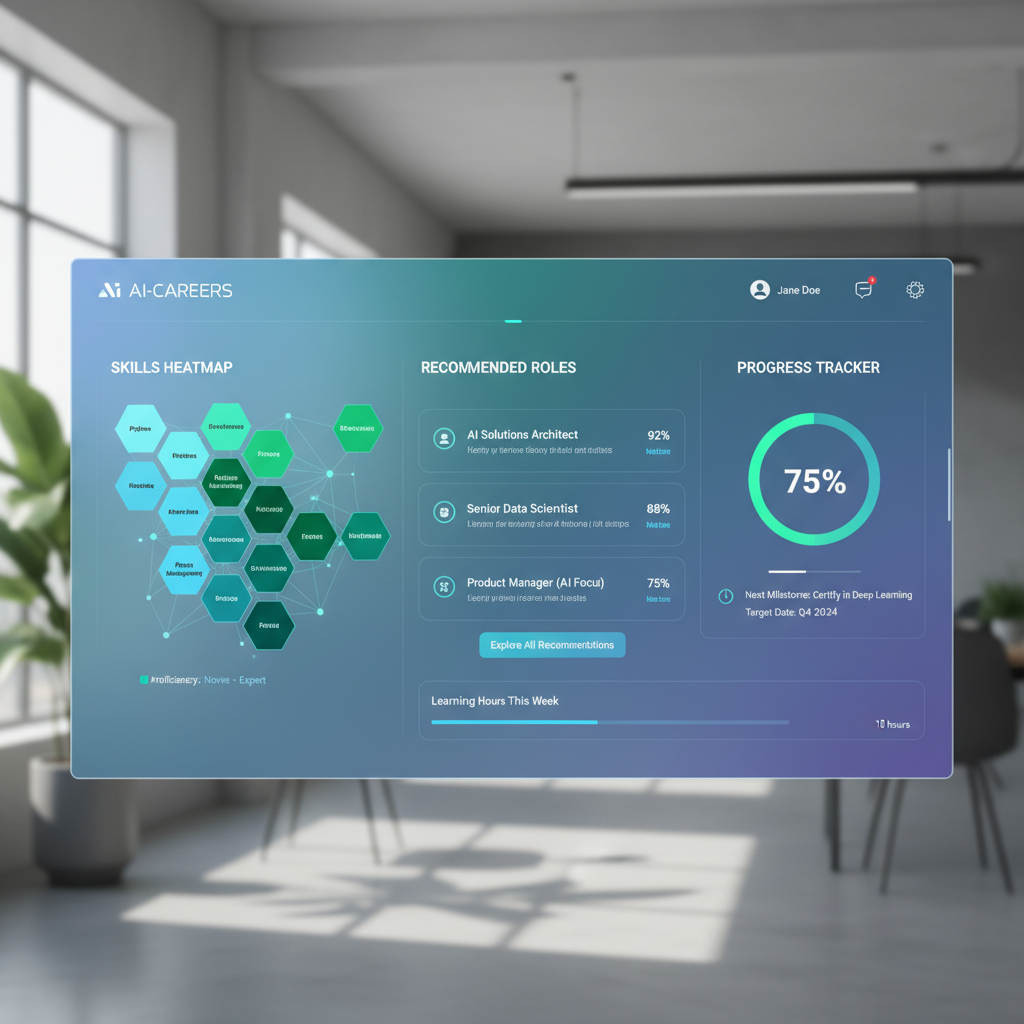
- Can I see sample dashboards or reports? (Screenshots of readiness scores, skills gaps, or interview analytics.)
- How often is the data refreshed? (Stale data in fast-moving fields like AI, UX, and data can mislead you.)
Step 2: Demand Human + AI, Not AI Instead of Human
The best programs position AI as the “always-on practice partner,” not your only guide. Look for:
- Live or asynchronous human coaching layered on top of AI tools (like the one-on-one coaching inside LLGI’s free Digital Career Accelerator or the mentorship pillar in Break Through Tech’s AI Program).[1][5]
- Opportunities to review AI outputs (like resume drafts or interview feedback) with a coach who can contextualize them.
Step 3: Price Anchor Smartly
Use three tiers to frame your decision:
- Free / low-cost, high-value: LLGI’s Digital Career Accelerator (free, with Google certificates and coaching)[1]; University of Maryland’s free AI & Career Empowerment certificate with career transition strategies and networking.[2]
- Mid-tier programs: Many cohort-based online accelerators and bootcamps with integrated coaching and AI tools tend to land in the USD $500–$2,000 range (varies widely by provider and length).
- Enterprise-grade platforms: BetterUp and similar solutions are usually bought by employers and priced per employee per month (often in the low hundreds), bundling deep behavioral analytics, coaching networks, and AI personalization.[7]
Once you’ve seen what the free and enterprise ends of the market offer, it becomes much harder for a $1,000 “AI-powered” course with a basic chatbot and PDF resume templates to pass your sniff test.
Step 4: Look for Signals of Serious AI Adoption
Outside of consumer programs, watch what professional associations and workforce bodies are doing—it’s a strong signal of where the field is headed:
- The National Association of Workforce Development Professionals (NAWDP) is running a 2026 Virtual Academy on AI to help workforce professionals integrate AI into their programs and improve outcomes.[4]
- NACE’s AI Bootcamp for Career Services offers immersive virtual training to help university career centers and coaches use AI in coaching and center management.[6]
If your prospective platform is aligned with this kind of thinking—integrating AI into real workflows, not just marketing copy—it’s a good sign.
Immediate Actions: Three Moves You Can Make This Week
1. Grab a Free AI-Career Baseline
Enroll in one free, structured AI-related program that includes career components:
- Digital Career Accelerator (LLGI) for Google certifications + one-on-one coaching and AI literacy.[1]
- AI & Career Empowerment certificate (University of Maryland) to understand how AI is transforming business roles and how to navigate transitions.[2]
These give you a realistic benchmark for curriculum depth, coaching structure, and how AI is framed in serious programs—without financial risk.
2. Stress-Test Any AI Interview or Resume Tool
Before committing to a long contract:
- Run one real job posting through the platform’s AI resume tool and see if the output feels specific, measurable, and tailored.
- Do one AI mock interview and assess whether follow-up questions feel reactive to your answers or just random.
- Ask a coach (if available) to review the AI feedback with you—this reveals how well humans and algorithms are integrated.
3. Define Your “Success Metrics” Up Front
Instead of hoping the platform “works,” set concrete outcomes for the next 60–90 days:
- Number of targeted applications you’ll submit.
- Number of AI-powered mock interviews you’ll complete.
- Specific skills or certificates (e.g., Google Data Analytics, AI Essentials) you’ll finish.[1]
Hold the platform accountable to those outcomes. If the AI tools and coaching aren’t clearly helping you move those metrics, you have your answer.

Your Next Move: Don’t Buy “AI”—Buy Outcomes
AI is now table stakes in the career coaching world. What separates the signal from the noise is whether a program’s algorithms, assessments, and simulators translate into faster clarity, stronger applications, and more offers—especially in fast-moving fields like AI, data, and digital roles.

If you want to get ahead of the curve, start by sampling one serious, free AI-infused program, then benchmark every paid platform against it. Ask where the data comes from, how the AI and humans work together, and what specific, measurable outcomes you can expect in 90 days. In a market crowded with “AI-powered” promises, the smartest move you can make is simple: pay for traction, not technology buzzwords.
Unlock Full Article
Watch a quick video to get instant access.