Think You’re “Fully Covered” On Your Bike? The 2025 Reality Check Every Rider Needs Before Their Next Ride
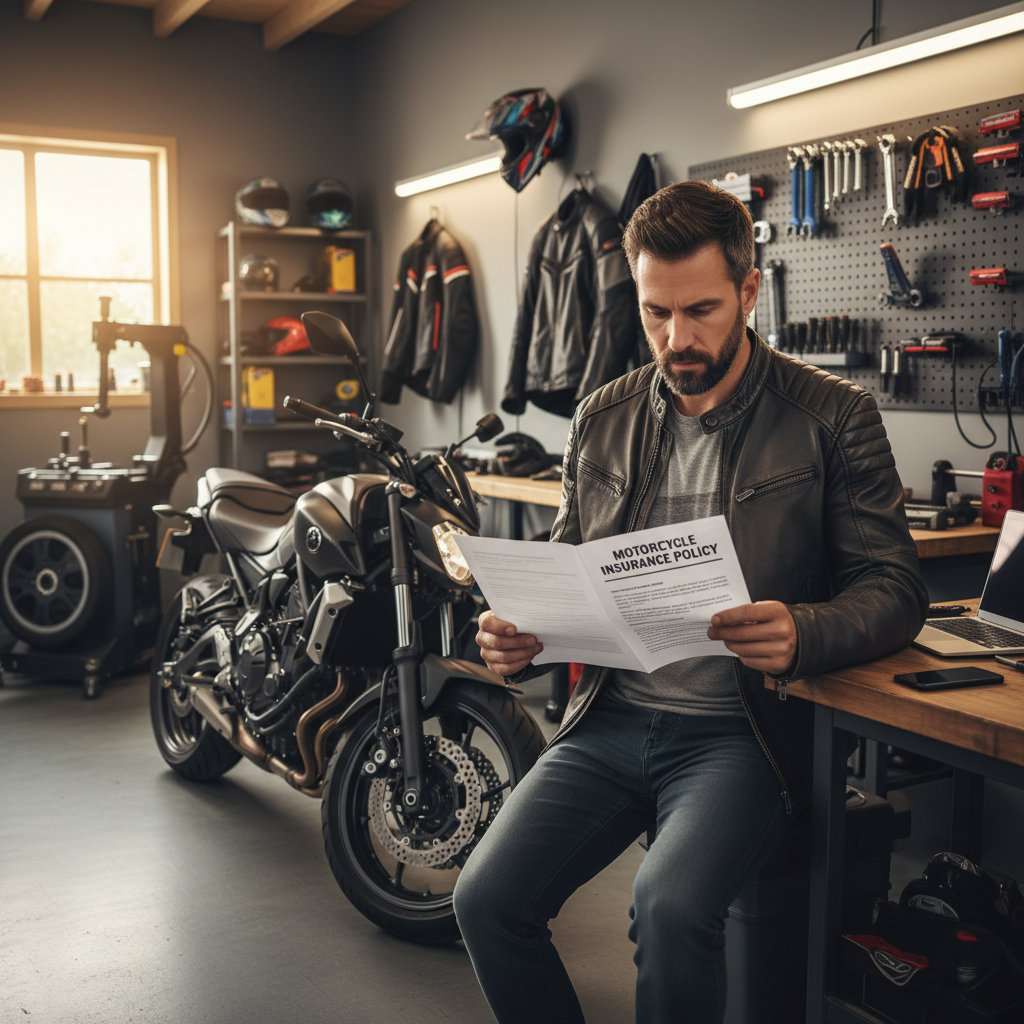
If you tell friends you have “full coverage” on your motorcycle, most will nod and assume you’re bulletproof. But in 2025, that phrase is more of a dangerous shortcut than a real guarantee. Rising theft rates, expensive electronics, and custom builds mean a standard package that looked solid in 2018 can leave painful (and very expensive) gaps today.[6][3]
Instead of asking “Do I have full coverage?”, smart riders in 2025 are asking: “Exactly what does my policy pay for, what doesn’t it touch, and how bad would the bill be if I laid it down or it disappeared tonight?”


The 2025 Reality: “Full Coverage” Is Just a Bundle, Not a Force Field
Insurance companies and comparison sites typically use “full coverage” to describe a policy that includes at least three core parts: liability, collision, and comprehensive coverage.[6][1][7]
That’s a good starting point, but here’s the catch: it says nothing about limits, exclusions, custom parts, your riding gear, or how you actually use the bike.
The Big Three Most Riders Assume Are “Everything”
Liability coverage pays when you injure someone else or damage their property in a crash you cause.[1][2][6] Almost every state requires at least a minimum liability limit.[1][10] For example, California’s minimum is 15/30/5 (that’s $15,000 per person, $30,000 per accident for injuries, and $5,000 for property damage).[1][3] Those numbers get blown past quickly if you total a new truck or seriously injure someone.
Collision coverage pays to repair or replace your bike if you hit another vehicle or object, regardless of fault.[1][2][3][6] You pay a deductible first (often $500–$1,000), then insurance covers the rest.
Comprehensive coverage handles non-crash damage: theft, fire, vandalism, weather, or hitting an animal.[2][3][4][6] With motorcycle theft surging in many urban areas, this is now essential even for older bikes.[4][3]
Put together, these three are what most carriers, including Progressive and others, casually label as “full coverage.”[6][7] But look closely and you’ll notice what’s missing.
The Surprising Gaps That Still Exist in 2025
A modern, tech-heavy motorcycle plus premium riding gear can easily represent $20,000–$35,000 of value. Standard “full” coverage often doesn’t follow that number.
1. Custom Parts & Upgrades: Your Add-Ons Are NOT Automatically Safe
Most policies with comprehensive and collision quietly include only a small amount of automatic accessory coverage (often around $2,000–$3,000) for non-stock parts.[3][1] After that, it’s on you unless you’ve added dedicated custom parts or accessory coverage.
Examples of what needs explicit protection:
- Aftermarket exhaust on a Yamaha MT-09 SP (~$11,499 MSRP)
- Custom paint and graphics on a Harley-Davidson Street Glide (~$25,000+ depending on trim)
- Hard bags and touring setup on a 2025 BMW R 1250 GS (~$20,000+ fully loaded)
Insurers highlight this gap directly: many state that custom parts and accessories are excluded unless you add them or raise the accessory limit.[1][3] In other words, your $4,000 in upgrades could net you maybe $2,000 in a claim unless you’ve deliberately increased that coverage.
2. Your Gear: Helmets, Jackets, and Airbags Aren’t Always Covered
Quality gear is no longer optional. A full kit—like a Shoei RF-1400 helmet (~$500), Alpinestars Tech-Air compatible jacket (~$700+), armored pants, boots, and gloves—often adds up to $1,800–$2,500.
Some modern motorcycle policies now explicitly offer safety apparel coverage to protect helmets, jackets, and other gear if they’re damaged in a covered accident.[3] But it’s not automatically bundled everywhere. Without that add-on, your insurer may treat gear as personal property and pay little or nothing.
3. Medical Bills: Don’t Assume Your Bike Policy Takes Care of You
In many states, motorcycle riders are not automatically covered by the same personal injury protections that apply to cars. Even in no-fault states, PIP often does not extend to bikes.[1]
Instead, you may need separate Medical Payments (MedPay) coverage or rely on your health insurance. MedPay can cover medical bills for you and a passenger regardless of fault and is offered by many carriers, but it is optional and not available everywhere.[2][3][5]
If you ride without MedPay and have a high-deductible health plan, even a low-speed crash can turn into a multi‑thousand‑dollar out-of-pocket shock.
4. Uninsured/Underinsured Motorists: The Other Driver’s Fault Can Still Break You
Uninsured/Underinsured Motorist (UM/UIM) coverage pays when the driver who hits you has no insurance or not enough insurance. In several motorcycle guides and 2025 buyer resources, this is flagged as essential protection.[2][3][5]
Yet many riders still decline UM/UIM to save a few dollars a month. With medical inflation and aggressive bike values, that can be one of the most expensive ways to “save” money.
5. How You Use the Bike: Commuting vs. Track Days vs. Side Hustles
Standard personal motorcycle policies are designed for normal personal use. Policies frequently exclude:
- Racing and track events[1]
- Stunt riding or organized competitions
- Commercial use (e.g., delivery or paid tours)[1]
If you’re running food delivery on a 2025 Honda Grom or doing paid moto-photography, you may need commercial vehicle coverage or endorsements, or a claim could be denied.[1]

What’s Changed in 2025: Theft, Repair Costs, and Why “Enough” Isn’t Enough
Two big trends are reshaping what “fully covered” should mean for you in 2025.

Theft and Non-Crash Losses Are a Bigger Threat
Insurers emphasize comprehensive coverage more heavily now because theft, vandalism, and weather events make up a growing share of claims.[4][6] High-demand models—like naked bikes, adventure bikes, and sport bikes with easy-to-part-out components—are particularly appealing targets.
If you park on city streets or in shared garages, running only liability plus collision and ignoring comprehensive is a serious FOMO situation: other riders in your area are getting full replacement payouts after theft, while you’d get nothing.
Repairs Are More Expensive Than Most Riders Realize
Modern bikes carry more electronics, rider aids, and expensive plastics. Fairing sets on mid‑range sport bikes can reach $2,000–$3,000 in parts alone, and ADAS-style features on premium touring and adventure bikes push repair bills even higher.[3][4]
That’s why some carriers and agencies now recommend:
- Higher liability limits than the state minimums (e.g., 50/100/50 instead of 15/30/5)[1][3][10]
- Total loss replacement or full replacement-cost options for newer bikes, especially in the first 1–2 model years[3][4]
With average full-coverage costs in some states around the mid‑$60/month range for standard bikes,[3][9] the price jump from “barely enough” to “genuinely sufficient” is often smaller than riders expect.
How to Audit Your Current Policy in 15 Minutes
Use this quick 2025 checklist to see how “full” your coverage really is. Grab your declarations page and compare it to your real‑world risk.
Step 1: Match Your Limits to Real-World Numbers
Check your liability limits. If you are at state minimum (like 15/30/5 in California), ask yourself:
“Could $5,000 really cover another driver’s car, let alone an SUV or truck?”[1][3]
Action: Aim for at least 50/100/50, and higher if you own a home or have assets to protect.
Step 2: Confirm Collision and Comprehensive Deductibles
Look at your deductibles. A $1,000 deductible might look cheap on paper but feel brutal after a low‑speed spill. The sweet spot for many riders is typically $500–$750, balancing premium and affordability at claim time.[1][2][6]
Step 3: List Your Bike’s True Value (Including Mods)
Write down your bike’s approximate market value (check classifieds or dealer listings) plus:
- All aftermarket parts and custom work
- Installed luggage and racks
- Electronics (GPS, heated grips, auxiliary lights, quickshifters)
Then compare that to your policy’s accessory/custom parts limit. Many policies default to around $2,000–$3,000 unless you’ve requested more.[1][3][5] If you’re over that, call your insurer and raise the limit.
Step 4: Add Gear and Medical Coverage if Needed
Check if your policy lists safety apparel coverage or similar wording for gear.[3] If not, ask about adding it and price it out. Do the same for MedPay and UM/UIM. These are the coverages that safeguard you, not just the bike.
Step 5: Align Coverage With How You Ride
If you:
- Commute daily in heavy traffic
- Park outside or in shared garages
- Ride long‑distance tours
- Do any paid or semi‑commercial riding
…tell your agent honestly. You may need roadside assistance, higher comprehensive limits, or commercial endorsements for certain uses.[2][3][8]

Real-World Example: Two Riders, Same Bike, Very Different Outcomes
Consider two owners of a 2025 Kawasaki Ninja 650 (roughly $8,500 MSRP):
Rider A asks for “full coverage” and accepts the default quote:
– State-minimum liability (e.g., 15/30/5)
– Collision and comprehensive with $1,000 deductibles
– No added accessory coverage, no UM/UIM, no MedPay
Rider B spends 10 extra minutes fine-tuning:
– 100/300/50 liability
– Collision and comprehensive with $500 deductibles
– Raises accessory coverage to $5,000 for exhaust, levers, rearsets, and luggage
– Adds UM/UIM and $5,000 MedPay
– Adds safety apparel coverage for helmet, jacket, and boots
They both get sideswiped in traffic. Rider A’s gear and several upgrades are effectively uncovered, and low liability limits leave them exposed if the other driver’s injuries exceed limits. Rider B pays a bit more each month, but walks away with bike repairs, gear replacement, and medical bills largely handled.
Next Steps: Turn Confusing “Full Coverage” Into a Policy That Actually Has Your Back
If you haven’t re‑shopped or adjusted your motorcycle coverage since before 2025, assume you’re underprotected. Repair costs, theft risk, and medical expenses have moved faster than most riders’ policies have.
Here’s what to do in the next 24–48 hours:

- Pull your current policy and use the five‑step audit above.
- List your bike’s true replacement cost, including mods and gear.
- Get at least 2–3 updated quotes from insurers that clearly spell out accessory, apparel, UM/UIM, and MedPay options.[3][6][9]
- Ask specifically about custom parts, safety gear, and total loss replacement for newer bikes.[3][4]
The riders who come out ahead in 2025 aren’t the ones paying the lowest premium—they’re the ones who know exactly what their policy will do before something goes wrong. Don’t wait for a claim to find out what your “full coverage” doesn’t cover.
Unlock Full Article
Watch a quick video to get instant access.