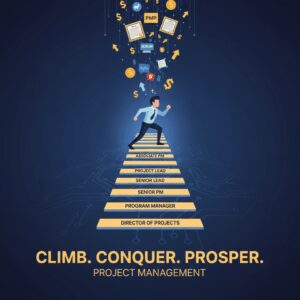
From Task Juggler to Project Boss: Your 0–10 Year Certification Roadmap That Hiring Managers Can’t Ignore

If you want to go from “Can you update this tracker?” to “You own this multi-million-dollar program,” you need more than hard work and a nice-looking resume. You need a deliberate certification roadmap that matches your experience level and the roles recruiters are actively trying to fill right now.
Instead of asking “What’s the best project management certification?”, flip the question: “Given where I am (0–10 years), what’s the next credential that will move my title, salary, and responsibilities up a level?”
This guide gives you a step-by-step, 10-year path from coordinator to PM lead, with specific certifications, timing, prices, and how each jump pays off in the market.

Stage 1 (0–2 Years): From Admin/Analyst to Credible Project Coordinator
At this stage, you’re probably a project assistant, coordinator, BA, QA, or even in a non-PM role (marketing, ops, IT) but doing “accidental” project work. Your goal: get taken seriously as someone on a project management track.
Core moves in your first 24 months
1. Build a quick foundation with low-risk, high-signal certificates
Hiring managers increasingly recognize entry-level, skills-focused credentials from big tech and PMI as a sign that you’re serious about PM, even with little experience. Recent industry guides highlight these as common ways to break in.[1][2][5]
- Google Project Management Professional Certificate (Coursera)
Approx. price: US$39–$59/month subscription depending on region. Most learners finish in 4–6 months, so budget ~US$200–$350.
Best for: Career switchers and fresh grads who need hands-on basics (schedules, stakeholders, risks) plus portfolio-style projects. - Project Management Institute – Certified Associate in Project Management (CAPM®)
Exam cost: About US$225 for PMI members, US$300 non-members (2025 pricing ranges).[4][5]
Prerequisites: Secondary degree (high school or equivalent) and 23 hours of PM education (which you can get via an online course).
Best for: Coordinators who want a globally recognized credential that says “I understand real PM processes, not just admin.”
Why this matters for your career: current roadmaps and salary reports show that certified professionals see faster promotions and higher pay than non-certified peers, even early on.[1][4][7] This is your first “I’m not just support; I’m a junior project manager” signal.
Immediate action plan (0–2 years)
- Month 0–3: Enroll in the Google Project Management certificate or an equivalent structured course to cover fundamentals fast.
- Month 3–6: Log your hours as “project work” (even if internal) and complete 23 hours of formal PM education.
- Month 6–12: Sit for CAPM®. Add “Project Coordinator / Junior PM” to your target titles.
- Month 12–24: Volunteer to own small initiatives end-to-end: pilots, internal process changes, feature launches. This builds the experience you’ll need for mid-level credentials such as PMP later.[1][3][5]
Stage 2 (2–5 Years): From Coordinator to Fully-Fledged Project Manager
With 2–5 years of experience, you’re likely running small to medium projects, managing timelines, and leading stand-ups. Recruiters now care less about whether you “understand PM” and more about whether you can handle complexity, budgets, and cross-functional teams.[3]
Choose your lane: Predictive, Agile, or Hybrid
Job trend reports for 2025 show a strong demand for project managers who are comfortable in both Agile and traditional environments, especially in tech, consulting, and product-led companies.[4][7] This is where you start to specialize while still staying employable across industries.
Predictive / Mixed environments (IT, infrastructure, corporate projects)
- PMP® Exam Prep Course (Project Management Professional)
Training cost: Typically US$500–$1,800 depending on provider and format (bootcamp vs self-paced).[4]
PMI exam fee: ~US$405 for members, US$555 for non-members.[4]
Prerequisites: Typically 3–5 years of project management experience and 35 hours of PM education.[2][4][5]
Best for: Professionals targeting roles like Project Manager, Implementation Manager, or Delivery Manager in organizations that emphasize structure, governance, and budgets. - PRINCE2® Foundation & Practitioner
Training + exam bundles are often in the US$900–$1,500 range depending on region and provider.
Best for: PMs in Europe, UK, government, or large corporates where PRINCE2 is the house standard.[1][5]
Agile-first environments (software, product, startups)
- Certified ScrumMaster® (CSM) – Scrum Alliance
Typical course + exam bundle: ~US$500–$1,000 depending on trainer and location.[4]
Best for: Scrum Masters, Agile PMs, and Business Analysts who want to move into delivery roles on Agile teams. - PMI-ACP® (Agile Certified Practitioner)
Exam fee: usually in the US$435–$495 range (member vs non-member).
Best for: Professionals who already use multiple Agile frameworks (Scrum, Kanban, lean) and want a vendor-neutral credential recognized by large enterprises.[1][4][5]
Why this stage is a turning point: multiple sources describe PMP as the “gold standard” and note that PMP-certified professionals often earn up to 30–35% more than their non-certified peers on average.[4][7] This is the moment where one exam can unlock an entirely different compensation band.

Practical roadmap (2–5 years)
- Year 2: Decide your primary lane (Agile-heavy vs mixed/predictive). Look at 20–30 job descriptions in your target industry and see which credentials appear repeatedly.
- Year 3: If you’re in Agile teams, grab CSM first—it’s fast to get and shows immediate alignment with how your team works.
If you’re in mixed or enterprise environments, start logging your project hours in PMI format (hours by process group) and enroll in a PMP prep course. - Year 3–4: Sit for PMP® or PRINCE2 Practitioner. Update your title targets to “Project Manager / Senior Project Manager” depending on your market.
- Year 4–5: Add PMI-ACP® if you want to be competitive for hybrid delivery roles and consulting, where clients expect both Agile and governance literacy.[1][4][5]
Stage 3 (5–8 Years): From Project Manager to Senior PM / Program Manager
At 5–8 years, you’re no longer proving you can run a project—you’re proving you can run several at once, manage dependencies, and make trade-offs aligned with strategy. Career path guides describe this move as shifting from “project delivery” to program-level thinking.[3][5]
Elevate from projects to programs
- PgMP® (Program Management Professional – PMI)
Exam + evaluation fees often fall in the US$1,000–$1,500 total range (member vs non-member). It’s a senior credential aimed at those managing multiple, related projects that deliver strategic outcomes.[1][4]
Best for: Program Managers, Senior PMs, and Delivery Leads in large organizations. - SAFe® Program Consultant (SPC) or SAFe® Release Train Engineer (RTE)
Typical training + exam: US$2,500–$3,500 depending on provider.
Best for: Managers working in scaled Agile environments who support multiple Agile teams, often in tech, telecom, or large product organizations.
Why now? Market reports show that as organizations adopt scaled Agile and complex portfolios, they pay a premium for professionals who can coordinate across teams and match projects to strategic goals.[4][7] PgMP- or SAFe-certified managers often move into six-figure salary brackets faster in North American and European markets.
Practical roadmap (5–8 years)
- Year 5–6: Shift your role from “owner of one project” to “owner of a stream.” Volunteer to lead cross-team initiatives or transformation workstreams.[3][5]
- Year 6: Start preparing your PgMP® application (which requires evidence of managing multiple related projects). Use your organization’s portfolio management tools (like Jira, MS Project, Smartsheet) to document this.[1]
- Year 6–7: If in a scaled Agile environment, target SAFe SPC or RTE. These certifications are frequently requested for Agile transformation and train-level leadership roles.
- Year 7–8: Position yourself for “Program Manager / Senior PM / Delivery Lead” titles with a clear narrative: you own outcomes, not just tasks.
Stage 4 (8–10+ Years): From Senior PM to Portfolio / PMO / Head of Delivery
By now, you’re expected to influence strategy, budgets, and organizational change, not just timelines. Career matrices show the top tier as Portfolio Managers and PMO/Delivery Heads, whose work shapes where the company invests.[3][5]
Move into portfolio and strategic leadership
- PfMP® (Portfolio Management Professional – PMI)
Exam and evaluation fees usually total around US$1,000–$1,500 depending on membership.
Best for: Portfolio Managers, Heads of PMO, and senior leaders who decide which projects get funded and how value is measured.[4][5] - Lean / Change Leadership certifications (e.g., Prosci Change Management, Lean Six Sigma Black Belt)
Typical investment: US$2,000–$4,000+ per program.
Best for: Senior leaders responsible for transformation, continuous improvement, and value-stream optimization.
At this level, the certifications are less about getting you “any” job and more about signaling to executive recruiters and boards that you understand portfolio value, change adoption, and enterprise risk.
Practical roadmap (8–10+ years)
- Year 8–9: Take ownership of a portfolio slice (e.g., all customer experience initiatives, all data projects). Track benefits realization, not just project completion.[3][5]
- Year 9: Prepare for PfMP®. You’ll need documented portfolio management experience and evidence of strategic decision-making.
- Year 9–10: Complement PfMP® with a change or Lean-focused credential to position yourself as a Head of PMO / VP of Delivery / Transformation Lead, not just a senior project manager.
How to Choose Your Very Next Step (Not Your Forever Path)
With all of these options, it’s easy to freeze and do nothing—which is the one choice that definitely won’t move your salary or title.
Here is a simple decision filter based on where you are today:
- Less than 2 years of PM experience? Start with Google Project Management Certificate → CAPM®. Your goal is credibility and vocabulary.
- 2–5 years and want bigger projects? Target PMP® (or PRINCE2 Practitioner if you’re in the UK/EU/public sector) and one Agile cert (CSM or PMI-ACP) to cover both worlds.
- 5–8 years and already leading multiple initiatives? Move into PgMP® or scaled Agile leadership credentials.
- 8–10+ years and influencing budgets? Aim for PfMP® plus change/Lean credentials to solidify your executive-track profile.
Call to Action: Lock In Your Next 12-Month Win
Don’t try to plan your entire 10-year journey tonight. Instead, choose one certification that matches your current experience band and commit to it as your 12-month project.
Right now, do this:
- Open 10–15 job postings for roles one level above your current title in your target industry.
- Make a tally of which credentials repeat (PMP, CSM, PRINCE2, etc.).
- Pick the most common one that you can realistically qualify for in the next 12 months.
- Set a test date 90–180 days out, put it in your calendar, and work backwards with a weekly study plan.
The PM market is crowded, but not saturated with people who have a clear roadmap. If you can show a recruiter that your last credential, current role, and next exam are all aligned with where you want to be in 3–5 years, you instantly stand out as someone on a leadership trajectory—not just another coordinator updating task lists.

Your future title—Senior PM, Program Manager, Head of Delivery—starts with the next exam you book, not the one you endlessly research. Choose, commit, and let the roadmap do its compounding work over the next decade.
Unlock Full Article
Watch a quick video to get instant access.