Is Your Personal Loan Offer Any Good? 2025 APR Benchmarks by Credit Score (So You Don’t Get Ripped Off)

You just got a personal loan offer… but is that APR normal, competitive, or quietly fleecing you over the next five years? In 2025’s high-rate world, most borrowers have no idea what a good personal loan rate looks like for their exact credit score—and that confusion is costing thousands in interest.
This guide is your 2025 rate “checkup”: clear APR benchmarks by credit band, real lender examples, and step-by-step moves to negotiate or keep shopping with confidence.
2025 Personal Loan Reality Check: Where Rates Actually Sit Right Now
Let’s anchor expectations before we zoom into credit score tiers.
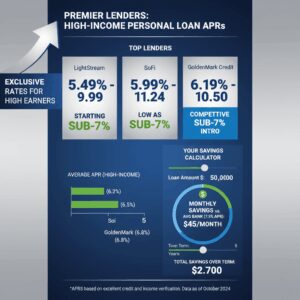
According to marketplace data from Credible, typical personal loan APRs across lenders in late 2025 fall roughly between 6.49% and 35.99%, depending on credit, term, and loan purpose.[1] Three-year loans for strong-credit borrowers (720+ FICO) are averaging around 13.83% APR, while five-year loans average about 18.46% APR.[1] Bankrate reports that the very best advertised personal loan rates for elite borrowers can start around the 6.24% range.[4]
That gap—from about 6% to 30%+—is why you absolutely need to compare your offer to your own credit tier, not your neighbor’s story.
What a ‘Good’ APR Looks Like in 2025 by Credit Score
Below are practical ballpark benchmarks for 3–5 year personal loans in 2025. These are not exact guarantees, but realistic expectations based on current lender and marketplace data.[1][2][4][5]

800+ FICO: Elite Credit
Target “good” APR range: roughly 6.5%–11% (excellent), up to ~13% still reasonable depending on term and lender.[1][4]
- Where that comes from:
– Credible notes that borrowers with exceptional credit are often eligible for single‑digit APRs and are the most likely to see rates below 10%.[1]
– Bankrate shows best-in-market personal loan rates starting near 6.24% for top-tier applicants.[4] - Real product examples (as of late 2025):
– Wells Fargo Personal Loan: Advertised rates “as low as” about 6.74% APR for qualifying borrowers with autopay and strong profiles.[5]
– Experian’s partner marketplace displays lender options with minimum estimated APRs in the 6.70%–7.99% neighborhood for the most competitive offers.[2] - Red flag for this tier: If you’re 800+ and seeing offers above ~14–15% for a standard 3–5 year loan with no unusual risk factors, you are likely overpaying. You should keep shopping and prequalify with multiple lenders.
740–799 FICO: Very Good Credit
Target “good” APR range: roughly 8%–15%, with anything under ~12% usually quite strong.[1][4]
- Data backdrop: Credible’s breakdown shows borrowers with “very good” credit tend to see APRs in the low-to-mid teens on both 3‑ and 5‑year loans.[1]
- Typical lender ranges:
– Many major banks and online lenders publish ranges like 7.90%–35.99% APR or 6.99%–35.99% APR, but borrowers in this tier usually fall toward the lower end of that spread, not the middle.[2] - Red flag: A 740+ score with a 3–5 year loan offer above ~17% APR (with no major quirks like high debt-to-income) means you should negotiate or walk away.
670–739 FICO: Good Credit
Target “good” APR range: roughly 13%–22%.[1]
- Credible data suggests that “good” credit borrowers often see APRs drifting closer to the high teens and even low 20s, especially on 5‑year terms.[1]
- On many marketplaces, the broad posted range might be 7.99%–35.99%, but in practice, mid‑tier scores cluster near the mid‑teens to low‑20s.[2]
- Red flag: If you’re in the 680–700 range and seeing offers north of ~24–25% APR, that’s edging into “only if it’s a true emergency” territory. You likely benefit from:
– Trying a credit union (many still advertise sub‑20% personal loan bands)
– Paying down revolving balances to bump your score before applying
580–669 FICO: Fair Credit
Target “less bad” APR range: roughly 22%–30% may be realistic; under 22% is strong.[1][2]
- Credible notes that fair‑credit borrowers often land at the higher end of the typical 6.49%–35.99% range, often pushing into the high 20s.[1]
- Experian’s partner offers show many lenders with upper APR caps of 27%–35.99%, particularly for longer terms or smaller loans.[2]
- Red flag: Above ~30% APR, you should ask: “Is there a cheaper plan?” Consider:
– Secured loans (with collateral)
– Working on your score for 3–6 months, then reapplying
– Debt management/credit counseling for high‑interest card debt
Below 580 FICO: Poor Credit
Reality check: Offers between 30%–36% APR are common.[1][2]
- Many mainstream personal loan lenders cap at about 35.99% APR, and borrowers with weak credit tend to be offered rates at or near that cap, especially without collateral.[1][2]
- At this level, the interest cost can rival or even exceed some credit cards. A personal loan might still help if you’re consolidating truly toxic payday debt, but for most, the smartest move is often to delay borrowing and rebuild credit.
How Loan Terms and Lenders Change What “Good” Looks Like
3-Year vs 5-Year: Why the Same Credit Score Gets Different APRs
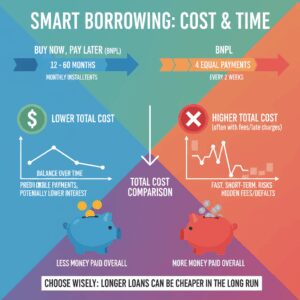
Even with identical credit scores, a 3‑year loan usually has a lower APR than a 5‑year loan.
Credible’s late‑2025 data for borrowers with 720+ credit shows average APRs of about 13.83% on 3‑year loans vs 18.46% on 5‑year loans.[1] Lenders charge more for longer repayment because they’re taking on more risk over time.
Action tip: When you evaluate if your rate is “good,” always compare it to benchmarks for:
- Your credit band
- and your loan term length (3 vs 5 years, etc.)
Marketplace vs Bank vs Credit Union
Where you shop makes a real difference:
- Online marketplaces (e.g., Credible, Experian’s loan partner network):
– Show multiple lender offers at once, with APR bands often like 7.90%–35.99% or 6.99%–35.99%.[2]
– Great for quickly checking if your offer is in line with what others with similar credit are getting. - Big banks (example: Wells Fargo):
– Tend to reserve the lowest rates (e.g., around 6.74% APR minimum) for existing customers with strong credit and autopay.[5]
– If you bank there and have good credit, your best offer may be in‑house. - Credit unions (example: State Employees’ Credit Union):
– Often publish narrower, more conservative ranges like about 9.25%–12.75% APR for 24‑ to 72‑month personal loans for qualifying members.[3]
– Especially competitive for good‑to‑very‑good credit borrowers.
Rule of thumb: Any time your offer is materially worse than what credit unions or top‑tier bank personal loans are advertising for your score (after accounting for term), you should assume there’s room to improve.
Instant Self‑Audit: Is Your Personal Loan Offer Competitive?
Use this quick checklist to decide whether to accept, negotiate, or keep shopping.

Step 1: Pin Down Your True Credit Tier
- Check your actual FICO score (not just a generic “credit score”) via your bank, card issuer, or a bureau like Experian.[2]
- Slot yourself into a band: 800+, 740–799, 670–739, 580–669, or below.
Step 2: Compare Against 2025 Benchmarks
- Find your tier above and see if your APR sits in the “good” or “red flag” zone.
- Adjust expectations based on term:
– A 5‑year loan at 14% might be better than a 3‑year loan at 14.5%, depending on your cash flow.
Step 3: Cross‑Check With Real Lender Ranges
- Look up several current offers from:
– An online marketplace (e.g., ranges like 7.90%–35.99% APR or 6.70%–35.99% APR from different partners).[2]
– A big bank (e.g., Wells Fargo’s “as low as” rate around 6.74% for strong borrowers).[5]
– A local credit union (e.g., 9.25%–12.75% for 24–72 month terms for qualified members).[3] - If your offer is closer to the top end of these ranges while your credit sits near the top of your tier, you can often do better.
Step 4: Use FOMO (and Facts) to Negotiate or Re-Shop
- Prequalify with 3–5 lenders (many, like Experian’s partners, allow soft‑pull prequalification with no impact to your FICO score).[2]
- Collect the best two or three offers.
- Go back to your preferred lender and say, “I’ve been prequalified for X% APR elsewhere. Can you match or beat it?” Some will say no—but a surprising number will sharpen their pencils when they see you’re informed and ready to walk.
Smart Next Moves If Your Rate Isn’t Where You Want It
1. Improve Your Score for a Quick Re‑Quote
Even a modest bump—from, say, 665 to 680—can move you from “fair” into “good” pricing territory, dropping APR by several percentage points.[1]
Fast‑impact moves:
- Pay down credit card balances to under 30% utilization (under 10% is ideal).
- Dispute obvious errors on your credit report.
- Avoid opening new accounts for a few months before reapplying.
2. Shorten the Term (If You Can Afford It)
As data from Credible shows, 3‑year loans currently have meaningfully lower average APRs than 5‑year loans for the same strong‑credit borrowers (13.83% vs 18.46%).[1] If you can handle the higher monthly payment, a shorter term can:
- Lower your APR
- Cut your total interest cost dramatically
3. Consider a Credit Union or Bank Where You Have History
Credit unions like State Employees’ Credit Union publish relatively tight, competitive ranges (e.g., roughly 9.25%–12.75% APR), particularly attractive compared with marketplace caps near 35.99%.[1][2][3] Existing‑relationship pricing at banks and credit unions can sometimes beat what you see on big comparison sites.
4. Don’t Ignore Fees—APR Tells the Real Story
An offer with a low interest “rate” but high origination fee can still have a high APR. Experian illustrates that a $10,000, 5‑year loan with an 18.73% interest rate and an 8.99% origination fee works out to a much higher 23.26% APR once fees are factored in.[2] Always compare APR vs APR, not just headline rates.

Your Call to Action: Do a 15‑Minute APR Checkup Today
Most borrowers simply accept the first personal loan offer they see—and quietly overpay for years. You don’t have to.
Here’s a concrete, one‑sitting action plan:
- 1) Check your FICO score and find your credit band.
- 2) Compare your current or proposed APR to the benchmarks above for your band and term.
- 3) Prequalify with at least three lenders (including one marketplace, one bank, and one credit union) to see real alternatives.
- 4) Use the best offers to negotiate down—or switch lenders if your current offer doesn’t budge.
In a 2025 market where average personal loan rates for strong credit sit in the mid‑teens and caps stretch toward 35.99%, knowing what’s good for your score is your edge.[1][2] Take 15 minutes today to run your own rate checkup—future you, with hundreds or thousands saved in interest, will be very glad you did.
Unlock Full Article
Watch a quick video to get instant access.